


How AI Is Raising the Standard of Passenger Experience in Aviation

Share

As artificial intelligence (AI) continues to mature, it reshapes how industries operate and deliver value, and aviation stands among the clearest examples of that transformation. With AI expected to sit at the center of discussions at APEX FTE EMEA and FTE Ancillary & Retailing, airlines increasingly deploy intelligent systems to enhance efficiency while directly improving the passenger experience.From American Airlines’ connection tracking technology to Delta’s AI-powered concierge and United Airlines’ mobile platform enhancements, carriers use data-driven intelligence to streamline the travel journey.
The shift extends well beyond the United States. flydubai’s Turnaround Management Program and Podeba’s humanoid robot Volodya illustrate how airlines worldwide adopt AI across both operational and customer-facing environments. Together, these initiatives show how artificial intelligence functions as a core component of modern airline infrastructure, shaping how carriers manage complexity and deliver service at scale.
Optimizing Passenger Connections Through Real-Time AI Decision-Making
As AI continues to evolve, airlines increasingly build it into daily operations with a focus on reducing uncertainty for travelers, improving operational precision, and creating smoother journeys from booking to arrival.
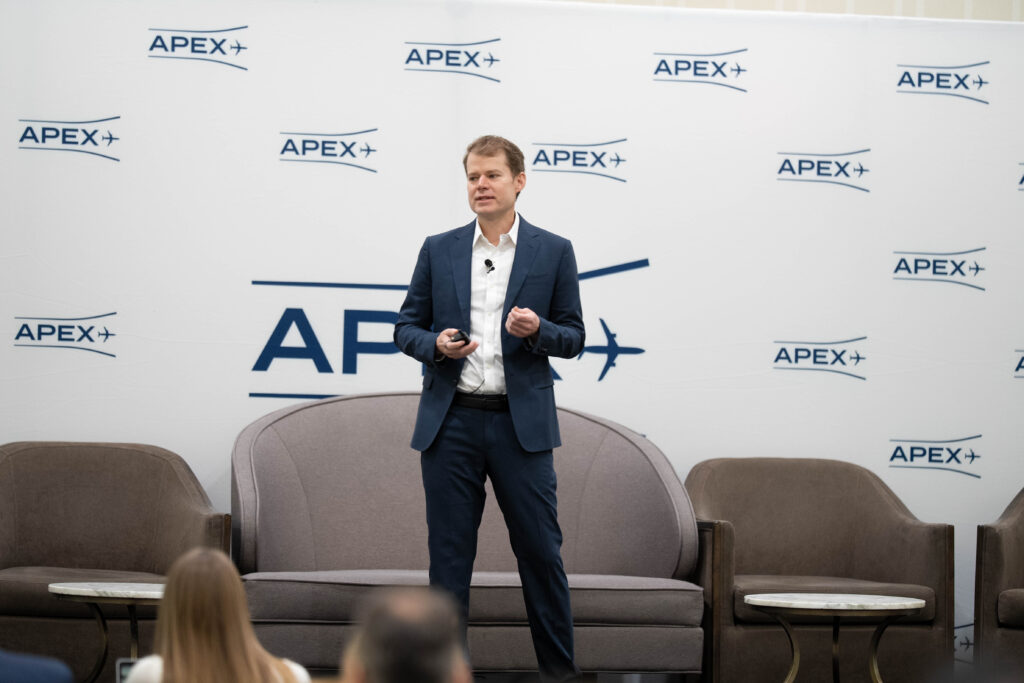
That shift framed the opening keynote at APEX TECH 2026, where Aeroméxico Chief Digital and Customer Experience Officer Andrés Castañeda Ochoa described how artificial intelligence and enterprise data strategies are reshaping the connected cabin. He outlined a future in which integrated intelligence supports every stage of the passenger journey while remaining largely invisible to the traveler. Castañeda closed by sharing Aeroméxico’s 2030 vision, where AI-driven systems maintain a real-time view of the customer and technology operates in the background to enable human service rather than replace it. “Hyper-personalization is no longer just a technology,” he said. “It’s the new standard in hospitality.”
American Airlines stands among the carriers putting that philosophy into practice. This summer the airline announced a new in-house AI flight-hold system designed to protect tight connections. The technology identifies departing flights with connecting passengers running behind due to delays and calculates whether a brief hold can occur without disrupting the broader network. If conditions allow, the system authorizes a short gate hold to improve the odds of a successful connection. Travelers receive automated messages explaining how long the aircraft will remain at the gate.
Early rollouts already show real impact. According to FOX News, travelers reported feeling relieved when AI alerts confirmed tight connections would not disrupt their plans, offering a clear example of how these tools improve the passenger experience in practical, noticeable ways.
AI-Driven Customer Support in the Delta Concierge
In October 2025, Delta Air Lines began testing an AI assistant called Delta Concierge inside the Fly Delta app, designed for SkyMiles members and focused on solving common travel friction. Delta Chief Digital Officer Eric Phillips explained, “Delta Concierge is more than just a digital assistant, it’s a reflection of how we’re using AI technology to blend the physical and digital experience.”
Delta Concierge answers routine questions about baggage status, gates, and flight updates. When the AI cannot resolve an issue, the system immediately routes the passenger to a live customer care agent, avoiding the dead ends associated with older chatbot systems. Voice activation adds another layer of convenience, allowing busy passengers to get answers while moving through the airport. Whether assistance comes from AI or a person, the priority remains responsive service.
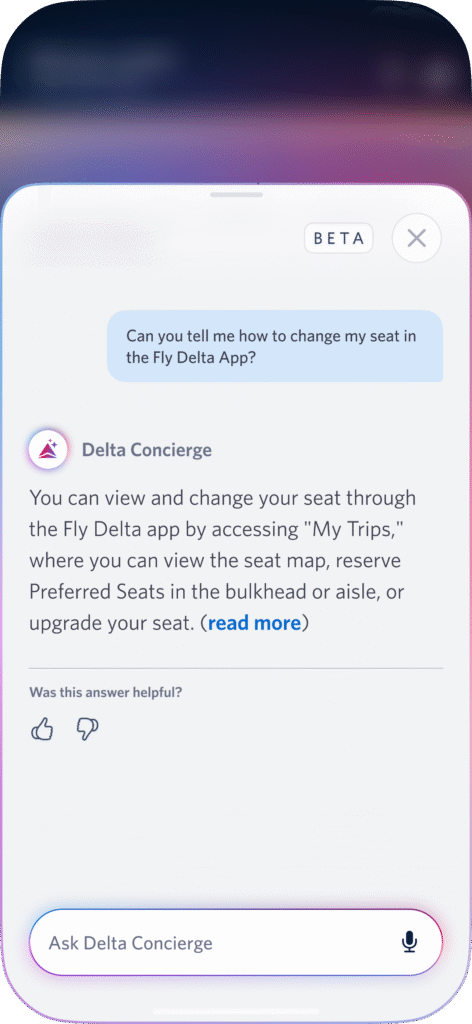
Beyond immediate support, Delta Concierge deepens personalization inside the SkyMiles ecosystem. “It’s one thing if you can get your questions answered on an app. If the app knows you and can answer your questions in a way that’s personal to you, that’s when the real feeling of connection and care happens,” APEX CEO Dr. Joe Leader explained.
Delta positions the Concierge as both a service tool and a loyalty engine. By recognizing the traveler and tailoring responses, the system strengthens engagement, encourages SkyMiles enrollment, and reinforces long-term relationships. The initiative illustrates how airlines deploy AI as a working tool that makes travel smoother, more personal, and more dependable.
Enhancing the Gate-to-Gate Experience by Mobile Integration
United Airlines applies a similar philosophy through its mobile app, building AI into a personalized gate-to-gate travel guide. In December 2025, the airline introduced estimated walking times between connecting gates, live delay notifications, and alerts when flights receive temporary holds. The stated goal is simple: save time and reduce uncertainty.
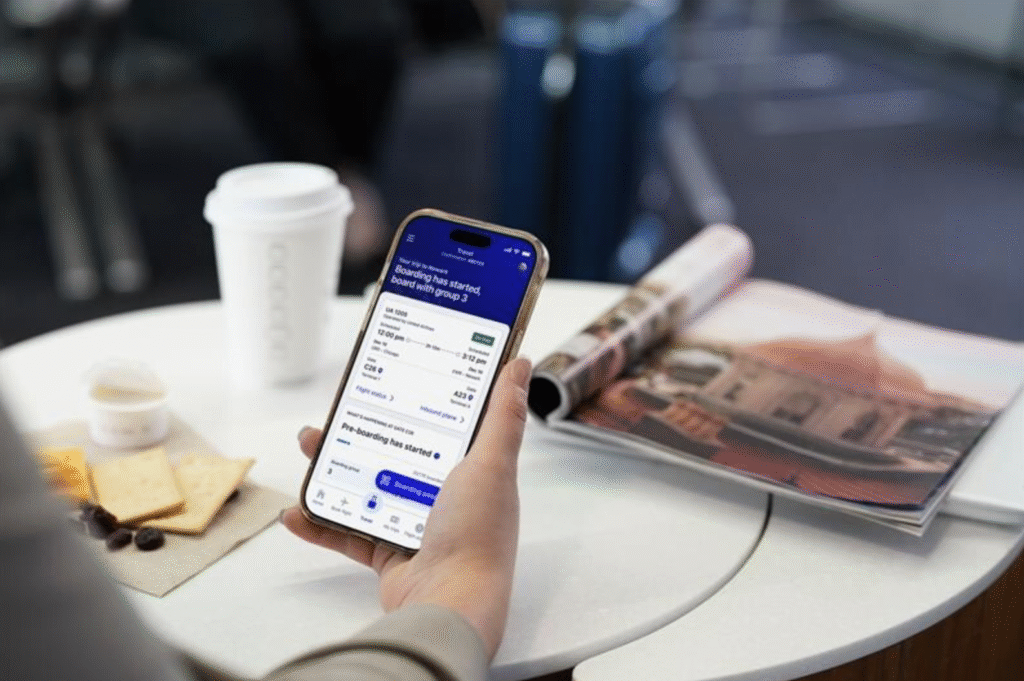
Additional tools target everyday airport friction. A Virtual Gate feature shows real-time boarding progress so passengers can wait nearby instead of crowding the podium. A “closest and best” recommendation engine highlights the most convenient United Club locations based on distance and availability. Arrival screens provide weather updates, landing time, and direct access to rideshare services. Together, these enhancements turn the mobile app into a real-time navigation layer for the airport journey.
Improving Operational Efficiency and Connectivity with AI
AI adoption extends globally, particularly in operational performance that passengers ultimately feel. In January 2026, flydubai selected ZestIoT to deploy an AI-powered Turnaround Management Program at Dubai International (DXB) and across its network. The system digitizes aircraft turnaround workflows, delivers real-time visibility, and helps teams anticipate disruptions before they escalate. Faster coordination translates into more reliable schedules and smoother connections.

ZestIoT Chief Executive Officer Amit Sukhija emphasized that flydubai committed to full deployment rather than limited trials. “While many in the industry are still piloting such solutions, flydubai is taking decisive action. With our multi-source data orchestration, visibility-driven with a smart AI agent platform, we are proud to empower their workforce, enhance collaboration, take smarter decisions and deliver measurable impact,” he said. The strategy highlights how operational AI improvements ripple outward to passenger experience.
Exploring Human-AI Interaction Through Humanoid Assistance
In a more experimental direction, Russian aviation company Podeba tested AI through a humanoid robot designed to assist cabin crew. The robot, named Volodya, joined a flight crew in late 2025 and performed basic attendant tasks. According to Interesting Engineering, it delivered safety briefings and interacted with passengers while mirroring human behavior.
The trial signals how far airlines are willing to explore AI’s role inside the cabin. Passengers reacted with curiosity, though sentiment leaned cautious. Even so, the experiment underscores a broader pattern: airlines continue testing emerging technologies to understand how human and machine collaboration may shape future service.
AI’s Role in Defining the Future of Air Travel
Artificial intelligence has shifted from promise to practice as airlines embed it into daily operations. Today carriers use AI to protect connections, deliver instant support, personalize loyalty engagement, and coordinate aircraft movements with greater precision. As the technology evolves, its presence will likely expand quietly rather than dramatically. Passengers may not see the algorithms behind the scenes, but they experience the result through smoother journeys and clearer communication. AI now defines the standard airlines build toward in passenger experience.