


Mighty Models

Share

This article originally appeared in The Entertainment Issue of APEX Experience.
In 2014, Boeing delivered a record 723 jetliners to airline customers. Airbus wasn’t too far behind, with 629 deliveries. But those numbers are nothing compared with the 983,533 aircraft delivered by Herpa Wings, a company based in the small German village of Dietenhofen. Each aircraft conveniently comes in a box. And is about six inches long.
Herpa Wings has been making highly detailed, scale aircraft models since the early 1990s, in both die-cast metal and plastic. The first model was a 1930s-vintage Lufthansa Junkers Ju-52, soon followed by a very exclusive series of plastic models of jetliners, also for Lufthansa. Stephan Külgen, Herpa Wings’ product manager, says, “That series was the start of aircraft models as collectables. Now, we make models of over 100 types of aircraft, each in many airlines’ liveries and registrations. Once a model is sold out, it won’t be available again.”
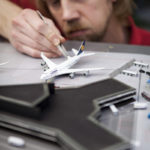
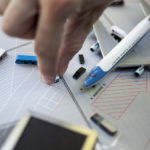
The most popular one in the Herpa Wings catalog is the Lufthansa Airbus A380, a 1:500 scale, die-cast metal model. “We’ve produced more than 100,000 of that model, with different aircraft registrations,” says Külgen. “We originally designed the 1:500 models and packaging to fit perfectly into the Lufthansa galley trolley, for on-board sale.” To get the details of each aircraft to a precision that would satisfy the most critical collector, Herpa Wings works closely with the aircraft manufacturers and airlines, and sources photos from around the world. The process of making the models is very labor-intensive, with each piece carefully produced, then inspected a myriad of times during assembly. Herpa Wings uses a pad-printing process to get crisp, color-accurate graphics onto each model.
Each is piece carefully produced, then inspected a myriad of times during assembly.
Herpa Wings competes with Gemini Jets, Hogan Wings, Skymarks and others for a slice of the multi-million dollar collectable market that includes not only aircraft models, but airport terminal buildings, ramp areas and vehicles as well. Many models are sold in-flight to passengers, but far more are snapped up by collectors. The Airplane Shop, with three locations in the US, is one of the retailers catering to these sometimes obsessive buyers. Paul Wettstein, director of operations, says, “We know of people who buy one of every model that comes out. Based on our demographic information, about 97 percent of our purchasers are male. And I think that the three percent who are women are usually buying a gift!”
DREAMY AIRLINERS
According to Wettstein, Boeing’s 787 Dreamliner is, overall, the current number one seller, based on the strength of the large number of airlines that have ordered the model. The Airplane Shop is also affiliated with Skymarks, one of the major producers of plastic models. “Air Force One is the most popular model in our plastic line. During election years, it sells really well,” says Wettstein.
A pad-printing process produces crisp, color-accurate graphics for each model.
Decades before the small-sized collectable market, er, took off, large aircraft models were showcased in the windows of travel agencies and airline ticket offices, and are still given as special gifts by airlines. Inaugural flights are very “model-worthy,” too. Earlier this year, to celebrate Air France’s first flight from Vancouver (YVR) to Paris (CDG), Patrick Alexandre, the airline’s executive vice-president, commercial sales and alliances, presented Craig Richmond, YVR’s president and CEO, with a model of the Boeing 777-200 that’s now flying the new route.
A SCALE ABOVE
These large models are produced by companies such as Miami-based Atlantic Models and PacMin, in Fullerton, California. Atlantic Models’ owner, Roger Jarman, says that his company produces about 5,000 models per year, all to order. “Our most popular model is the desktop-sized, 14-inch-long, 1:100 scale Boeing 737. We get lots of orders for that airplane from airline employees,” he says.
Those models are made from a polyurethane resin, with the original pattern for the aircraft carved from Spanish red cedar. A silicone rubber mold is made from the wooden pattern, and then a small number of models are resin-cast from each mold. The models are painted, matching the colors on the full-size aircraft. The artwork is produced in-house on water-slide decals, just like those in a plastic model kit. After being applied, the detailed graphics are protected with a clear-coat.
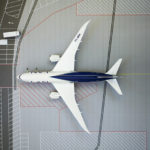
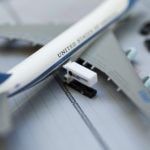
“We have a lot of fun with the airlines when they’re designing a new paint scheme,” says Jarman. “But we have to keep everything ‘top secret!'” Atlantic Models was entrusted by Southwest Airlines to create Boeing 737 models with proposed variations of the airline’s new livery during an 11-month-long gestation. For Southwest, Atlantic even made models with different designs on both sides of the airplane to show nuanced revisions as the design was finalized. As Jarman explains, being able to see and hold an accurate 3-D model of a new livery has so much more impact than any paper of monitor-displayed side drawing can accomplish.
ORDER UP
Anyone can get a unique model from Atlantic Models in about two weeks, not just airlines or aircraft manufacturers. “People have ordered models of the airplane on which they had their first flight, or were born on. We’ve had couples get the airplane they flew on when they first met,” says Jarman. Atlantic Models will also make huge fiberglass models for outside display. “We’ve built 42-foot-long, 1:3 scale models of the Embraer 195 for Azul Airlines. And there’s a collector in Panama who has ordered a 39-foot-long model of an Embraer 190 for the two-and-a-half-story atrium of his new house,” he adds.
Your Humble Correspondent (YHC) admits to having a small collection of about a dozen models. But after researching and writing this article, an idea is circling. YHC’s first flight was on a Trans-Canada Airlines Douglas DC-8 in the early 1960s. Now, where’s Roger Jarman’s phone number?
“People have ordered models of the airplane on which they had their first flight.” – Roger Jarman
Stephen Koulouthros is the super-collector who’s ordered the 39-foot-long model of the Embraer 190 for the atrium of his new home in Panama. He’s designed the atrium as a “Museum of Air,” showcasing the 2,200 models he’s collected over 38 years, and recently insured for $1 million. “I love airplanes,” says Koulouthros, not surprisingly. “I’m a pilot, and I’ve worked in the airlines.”
On the other side of the Atlantic, super-collector Gökhan Sarigöl figures he’s invested “around $2 million” in his astounding collection of more than 5,000 models. He started collecting in 1980 as a hobby, while living close to the Istanbul airport, and now operates an airlines services company in Turkey. Even with such a mammoth collection, Sarigöl has his favorites. “I love them all, but especially the metal Vickers Viscounts, made in the 1950s by Walker’s Westway Models in the UK.”
While collectors like Sarigöl and Koulouthros cast a wide net, others specialize in one area of interest. Seattle-based aviation writer Bernie Leighton travels all over the world chasing Cold War-era, Soviet-built aircraft, oftentimes having arranged to be a passenger in an incredibly loud and questionably safe airplane. About a third of Leighton’s 300-model collection features “Iron Curtain” aircraft with unpronounceable names of obscure types unknown even to enthusiasts. “My favorite is my Myasishchev 3MD Soviet Air Force cruise missile bomber. Only nine of the actual airplane were built in 1960,” says Leighton.
In Montreal, visitors to the offices of travel industry executive Joel Ostrov are greeted by a wall of almost 50 large desktop aircraft models. Beautifully lit, the display could be at home in a museum, and is equally well curated. Showpieces include a BOAC-Cunard Vickers VC-10 and an American Airlines Convair CV-990. Ostrov got the airplane bug as a kid, after taking a flight from Montreal to Miami with his parents. A model of that Eastern Air Lines Boeing 727-100 sits proudly on his desk.