


Ahead by a Century

Share
This article originally appeared in The Technology Issue of APEX Experience.
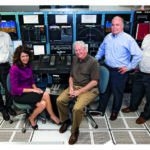
In a small, ordinary boardroom at Honeywell Flight Test Operations in Phoenix, Arizona, Jim Fusaro, the company’s vice-president of marketing and product management for mechanical sub systems, poses a rhetorical challenge: “Can you name how many companies have been in business for more than 100 years?” The answer? Not many. In the United States, maybe 500. One hundred years ago, the average lifespan of a company on the S&P Index was 67 years. Now, it’s 18.
It’s no coincidence that in 2014, Honeywell marked its hundredth year in the aerospace industry alongside the University of Michigan and MIT – both celebrating the centennial of their respective aerospace programs. The year 2014 also marked the 111th anniversary of the Wright brothers’ first flight; 100 years since Lawrence Sperry flew over the Seine – standing in the cockpit with both arms waving at the crowds – demonstrating the first aircraft autopilot; and the 100-year anniversary of commercial aviation. Needless to say, 1914 was a pretty important year.
Another important year for aerospace was 1946, the year the computer was invented. While introduced almost 50 years after aviation’s milestone year of 1914, computer technology quickly made its way onto airplanes – and has been a crucial component of aerospace engineering since. It’s not by chance that a number of Honeywell’s employees have backgrounds in both fields. Joe Duval, chief test pilot at the company’s Sky Harbor Flight Test Operations, completed his software engineering degree before joining the Air Force and launching an impressive career as a pilot. Conversely, Dean Wilkens, senior chief engineer of flight controls, has clocked over 1,000 hours as a flight test engineer, has had his pilot’s license since 1976, and he even owned his own plane. According to Wilkens, aspiring aerospace engineers should “Learn to fly. It’s the best way to understand airplanes.”
When Computers Fly
In the 1980s, new aircraft designs were still largely being realized in two dimensions, sketched with ink on large sheets of Mylar. Boeing engineers were searching for a new design to fill the size and range gap left between the mid- to large-sized 767-300ER twin-engine airliner and the jumbo 747-400. They floated proposals for a larger version of the 767, the 767X, but the design fell short of market needs for a jetliner with lower operating costs that could offer intercontinental range capability with a wider and more flexible cabin. Boeing engineers needed more than just a clean sheet of Mylar: They needed a computer.
Launched October 1990, the 777 program was unprecedented in many ways. It was the first jetliner to be completely designed on a computer, without a single paper-made blueprint. It would also be the first commercial transport manufactured by Boeing that employed a digital fly-by-wire primary flight control system, exchanging mechanic cable controls with electronic computers and transducers. To provide the Triple Seven, as it is often called, with the “best brains” in the industry, Boeing turned to Honeywell to develop the first-ever fully integrated modular avionics system for air transport.
Aiming for the Top
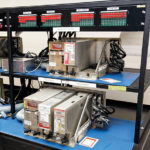
Much like our own brains, the aircraft’s brains – computers, that is – have evolved to become highly efficient and much more compact: The biggest computer in the world 50 years ago had less power than what we carry in our briefcases today. Honeywell’s Airplane Information Management System (AIMS) forms the largest central computer on the 777, consisting of 613,000 lines of software code and accounting for almost 25 percent of the Triple Seven’s 2.6 million lines of code (compared with only 400,000 lines total on the Boeing 747-400).
Like the human brain, AIMS sends electrical signals throughout the aircraft, controlling crucial functions such as flight management (helping pilots determine their route), displays, aircraft condition monitoring and central maintenance. Before AIMS, each one of these functions resided in its own box with its own computing brain, power supply, and input and output systems. These individual boxes added up fast, numbering into the hundreds, each one adding weight to the aircraft and requiring its own share of power.
The clean slate to work with on the 777, along with recent developments in microprocessor and computer memory technology, meant that Honeywell engineers could set out to make a single, highly integrated and advanced airplane information control center. “This was kind of a revolutionary concept,” explains Mark Anderson, the company’s chief engineer of Air Transport Integrated Avionics Systems. And in 1990, it was no small order.
Designed to keep duplicated resources to a tidy minimum, each function in AIMS’ dual cabinet system shares a common processor, power supply, input and output ports and operating system – rather than having its own. As a result, the new system is dramatically smaller, weighing 25 percent less than its predecessor. Though dramatically smaller, the system still maintains a tremendous level of redundancy. The right and left cabinets are essentially the same, and within each one, additional layers of redundancy are built into the system, because, as Anderson explains, “Things do break.” But, designed to have a reliability of at least 50,000 hours – roughly 10 years in the commercial aviation industry – they don’t break often.
When they do, though, the built-in redundancy measures turn what might have been a safety issue into a quick and easy maintenance operation. The simplicity of the system – requiring fewer hardware units and parts – and its efficiencies have played a large role in helping the 777 to achieve the industry’s highest twin-aisle dispatch-reliability rate of 99.3 percent. “In fact, they can even dispatch the airplane with equipment failure. That’s how much availability and redundancy there is,” Anderson says.
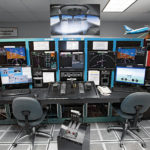
The success of the Triple Seven was as much a feat in computer science as it was in aeronautical engineering. Standing in Honeywell’s 777 Validation Facility in Deer Valley, where new software and hardware are continually being developed and tested on a full cab model, Anderson marvels:
All these airplanes are really flown on software. … The whole world is software these days. It didn’t used to be that way.
Cloud Computing
A crucial component of any AIMS is the flight management system (FMS), which helps pilots determine their flight path. But development of the first digital FMS was already underway a full decade before the development of AIMS and the 777. The fuel crisis in the 1970s put pressure on the industry to optimize its navigation capabilities, and for Honeywell, that meant out with the papers and in with the computers.
“In the old days,” explains John Hillier, Honeywell’s senior chief engineer of flight management systems, “it was all in paper charts, and you had to look them up. … The flight engineer would map the route, keep track of fuel [and so on].” So, when the engineers at Sperry Flight Systems (now Honeywell) invented the first digital FMS, the flight engineer was no longer needed in the cockpit. “Lots of people don’t know that old story,” Hillier says with a wink.
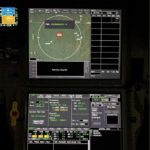
The first FMS was unveiled and certified in 1984. The system could accurately calculate the aircraft’s position, automatically compute and fly full 3-D flight trajectories, and incorporate the unique aerodynamic characteristics of the airframe and engines to try to provide the most fuel-efficient route possible. “The whole world is stored in the database, all the routes you can fly,” Hillier adds. For the display and entry of the FMS alphanumeric data, Honeywell engineers developed a new interface called the Control and Display Unit, which Honeywell claims as “the first true computer terminal in an air transport aircraft.” Undoubtedly, 1984 proved to be another very important year.

Advancing Technology
When the electronics industrialist Mark C. Honeywell founded Honeywell Heating Specialty Co. 109 years ago, airplanes couldn’t fly, computers didn’t exist and weather was an unmanageable thing controlled by divine forces. He certainly couldn’t have imagined how much technology and his company would change. But as Anderson points out, “It all starts with an idea.” And as with most ideas, “You can’t do it without technology and innovation,” adds Fusaro. “We’ve got 22,000 technologists globally … and that’s really the backbone of the entire organization. And we’re going to continue to invest heavily in research and development because that is the key differentiator.”