


APEX EXPO 2025: Scott Kirby’s Fireside Finale Maps United’s Strategy for Brand Loyalty, Global Growth, and Defeating AA in Chicago
Share
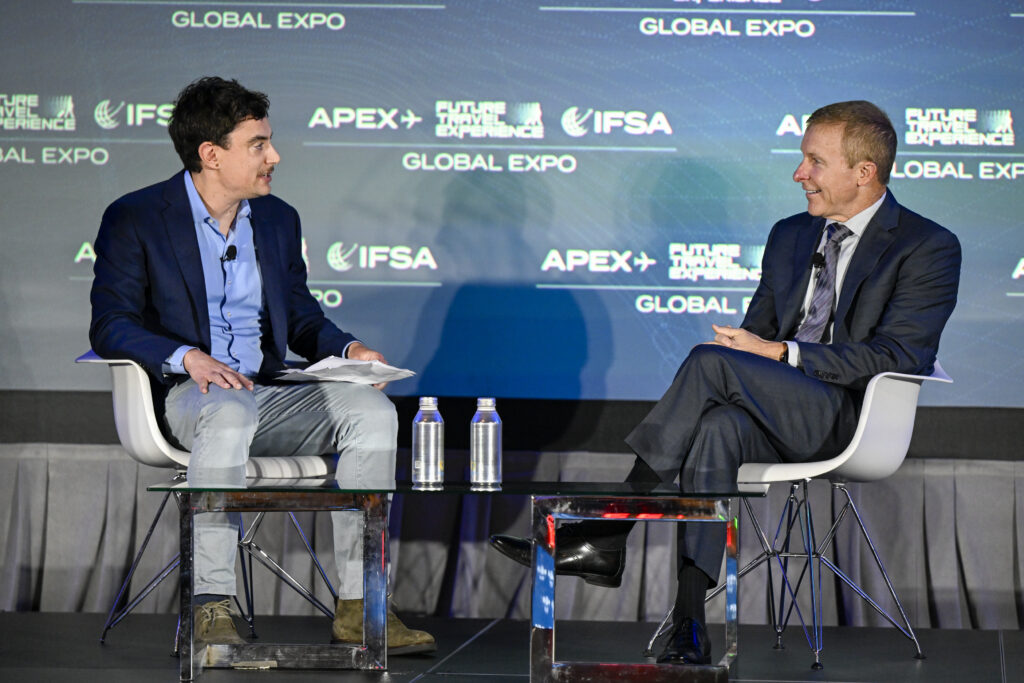
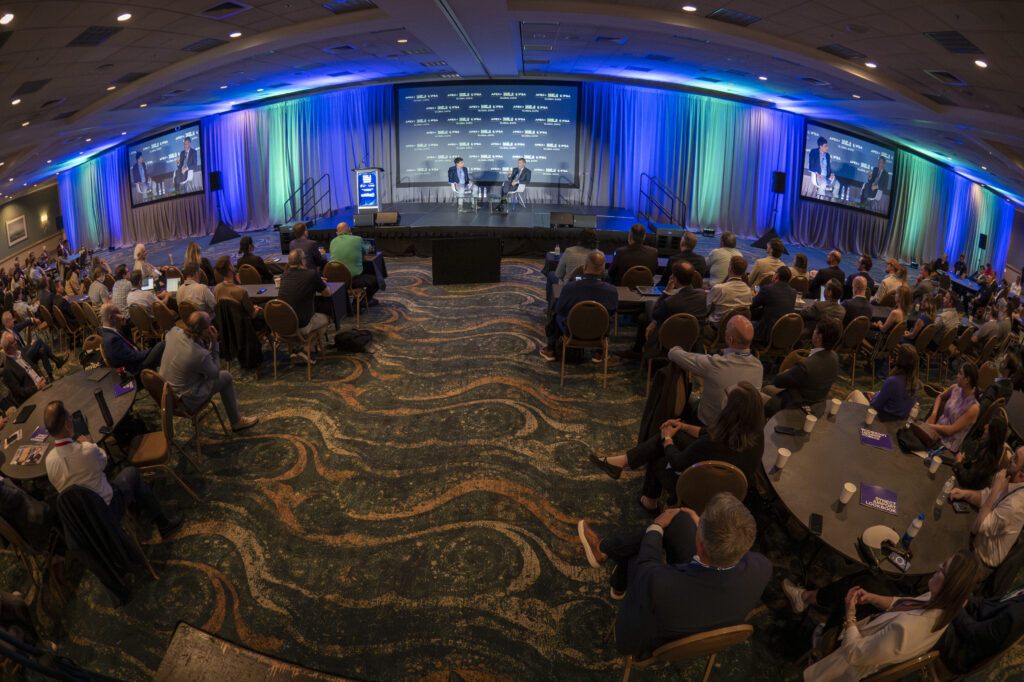
As APEX Global Expo 2025 came to a close, United Airlines CEO Scott Kirby took the stage for the Fireside Finale with The Airline Observer Editor Brian Sumers. He outlined United’s long-term strategy focused on customer investment, disciplined growth, and global competitiveness, offering a vision of an airline built to lead on the world stage. United is executing a long game that moves beyond domestic rivalry and toward global ambition.
Hub Discipline as Strategy
Kirby pointed to Chicago as his prime example, showing how United’s refusal to react to American’s expansion strengthened their brand-loyal strategy. After American added 100 flights a day, he said United did “absolutely nothing.” Kirby noted that Chicago has been United’s second-best performing domestic hub during the second and third quarters and the number one international hub. “When you are the brand-loyal airline, you can ignore what everyone else is doing and keep executing your plan,” he said.
Kirby also asserted that American’s losses in Chicago are not sustainable. “American Airlines is now losing around $800 million a year in Chicago,” he said. “That is not sustainable.”

He applied the same logic to Delta’s new long-haul announcements from Los Angeles, where they will launch a daily service between Los Angeles and Hong Kong and Los Angeles and Chicago, both beginning next summer. “This goes back to two routes out of 6,000 flights a day,” he said. “Because we have brand-loyal customers, we just execute our plan.”
Kirby explained that when a new airline enters a hub market, “United will lose a fair share of the price-sensitive customers, but will retain the brand-loyal customers […] This goes back to two routes out of 6,000 flights a day,” he said. “Because we have brand-loyal customers, we don’t change anything.”
Competition and Collapse
That same logic framed his view of Spirit Airlines, which filed for Chapter 11 bankruptcy protection earlier in the week.Kirby responded bluntly. “They have a business model that customers hate and one that is predicated on screwing the customer,” he said. “On the cost side, it was a Ponzi scheme. On the business side, it was a bait and switch.”
“That is a fundamentally broken business model, and the consumer has voted. They are going out of business because customers do not like their product.” When asked why he was so sure Spirit would not reemerge from bankruptcy, Kirby responded, “Because I am good at math.”
He then predicted “a bit of a bloodbath” in Florida but said United would not jump into every fight with competitors. “We only fight battles from the high ground,” he said. “We do not engage in battles where we have a losing hand. I do not believe in strategic flying. The graveyard of airlines is littered with headstones that say strategic flying.”
“The graveyard of airlines is littered with headstones that say strategic flying.”
United’s Fleet and Long-Haul Strategy
Kirby said United’s next frontier is the global stage, where he believes US airlines trail government-supported competitors. “Two-thirds of long-haul seats to and from the United States are on foreign carriers, even though 60 percent of the passengers are US citizens,” he stated. He argued the main reason for this is that many international airlines are backed or subsidized by their governments, so they can add capacity without worrying about profitability.
Now that United has built a strong customer base at home, the challenge is figuring out how to compete globally with products travelers prefer, even against Middle Eastern carriers. As such, United’s goal is to build a product that customers choose over foreign rivals. “We have an imperative to compete profitably,” he said. “We want to create an airline that all Americans can be proud of.”

That ambition is directly linked to fleet renewal. Asked whether the long-deferred Airbus A350 order could reemerge, Kirby said timing and economics are shifting as the airline retires its fleet of Boeing 767s.
“By the end of the decade, we will be well into retiring the 767,” he said. “It is a natural time to at least think about whether to make the Airbus A350 order firm in the 2030 timeframe.” He added that their “bad” 2017 Rolls-Royce engine deal now looks less unreasonable because engine prices have gone up so much.
“I want us to eliminate the trade deficit that the United States has in global long-haul service.”
Investing in the Passenger Experience
Turning to passenger experience, Sumers questioned Kirby on investments in catering, particularly United’s recent upgrades. “You can’t prove that $50 million drives a dollar more of revenue or drives someone to choose United, ” Kirby responded. “But when you add it to everything else, the whole is greater than the sum of the parts. At most airlines, when you are trying to cut expenses, the things you can change are to do with he customer. We now do the opposite.”
Kirby acknowledged his past role in cost-cutting decisions but said the philosophy has changed. “I have done those things in the past, but the realization is we now add incremental customer investment no matter what,” he said.
This commitment extends to premium cabins. Kirby confirmed that United’s new Polaris Studio concept is a first step toward reclaiming ground lost when US airlines exited international first class. “I want us to eliminate the trade deficit that the United States has in global long-haul service,” he said. “This is a baby step into maybe what that looks like. But we can’t do it while losing money.”
Technology was also highlighted as a differentiator for customer experience, particularly United’s in-seat screens and adoption of Starlink Wi-Fi. He described a new moving map that shows aircraft positions during long taxi times that was brought to fruition within six weeks. “It’s a small thing, but it’s cool,” he said. “When you land, you can see where you are in the taxi line. That’s the kind of innovation that makes customers think, ‘this is an airline I want to fly.’”
When asked about disclosing financial results from United’s connected media initiatives, Kirby was tight-lipped, but confirmed that targeted advertising is already delivering value. “It is incredibly successful with the brands that have used it, because we know a lot about the customers and what they are interested in,” he said. “It is a little creepy, but it works.”