


APEX EXPO 2025: Studios Address In-Flight Streaming Rights Challenge

Share
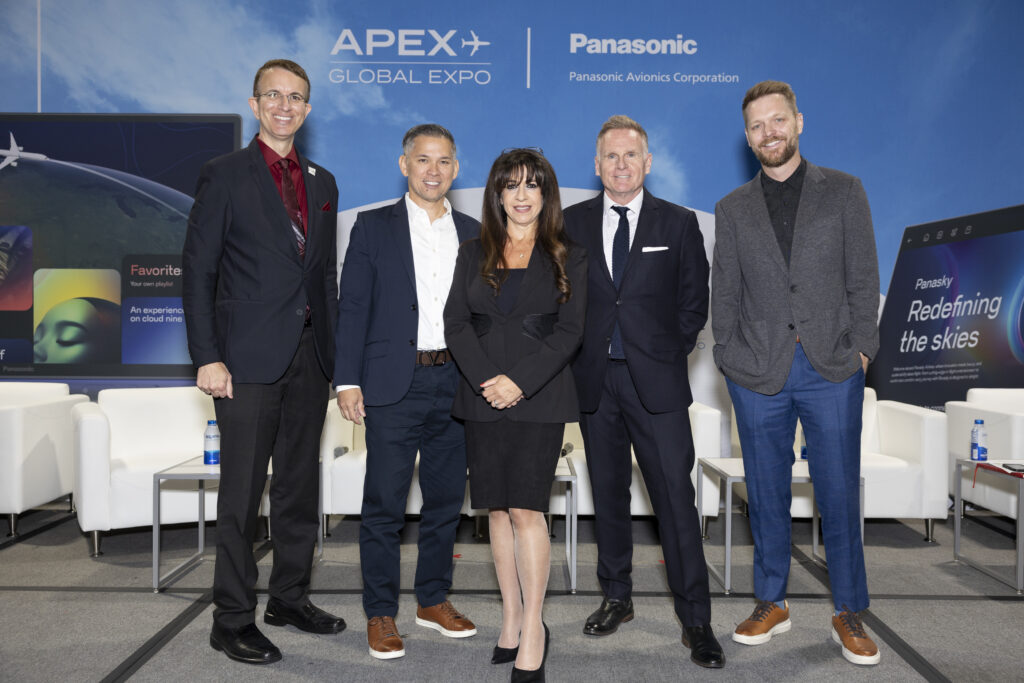
The mounting tension between passenger expectations for streaming and the intricate legal frameworks that govern content rights dominated the stage at APEX Global EXPO. Leaders from Disney, BBC Studios, Paramount Pictures, and Sony joined APEX Group CEO Dr. Joe Leader to tackle one of the industry’s most pressing questions: how can airlines satisfy demand for seamless digital entertainment while still protecting the financial value of premium content in the sky?
Passengers increasingly expect the cabin experience to replicate their living rooms, yet the legal ground rules for distributing content at altitude remain far stricter than those at home. Streaming has reshaped consumer behavior on the ground, but its rules in the air continue to evolve. Dr. Leader framed the conversation with clarity, stressing that industry stakeholders must respond quickly to prevent costly missteps.
“The consumer misconception is, ‘If I can stream it at home, I can stream it in the air,” he said. He went on to remind the audience that no major streaming platform currently grants in-flight access under standard terms and conditions. “Airlines are treated as a broadcast venues, and the rights holders have the rights to actively defend their inquired channels.”
“The consumer misconception is, ‘If I can stream it at home, I can stream it in the air.”
– Dr. Joe Leader, APEX
While a formal recommendation from APEX approved by an antitrust legal panel is forthcoming, Dr. Leader suggested airlines avoid promoting unrestricted streaming until consensus on licensing standards develops. To further advance the industry for the future, APEX has introduced STREAM (Standardized Technical Rights Enforcement for Airline Media), a framework designed to gather perspectives from airlines, studios, content service providers (CSPs), and connectivity companies. STREAM aims to clarify the licensing landscape and reduce uncertainty around in-flight streaming.
The panel explored not only the risks of bypassing licensing requirements but also strategies for collaboration between airlines, technology providers, and studios to create an in-flight entertainment (IFE) experience that balances legal compliance with passenger delight.
Balancing Revenue and Passenger Expectations
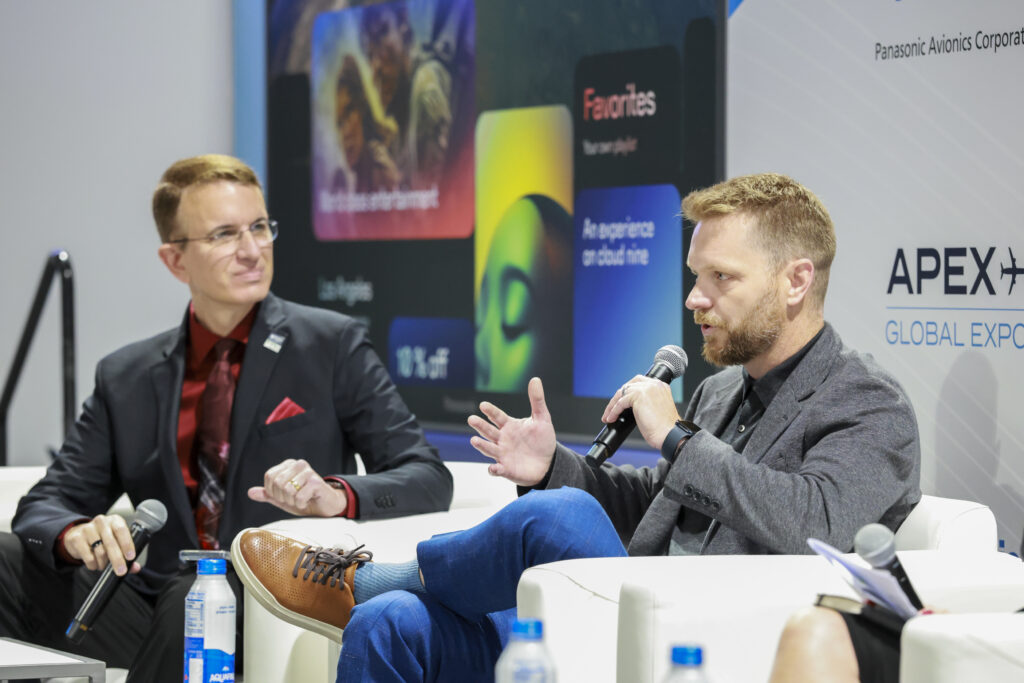
Disney Vice President of Platform and Distribution Sales Christopher Hill emphasized the commercial importance of in-flight licensing both as a revenue channel and as a showcase for the company’s global portfolio.
“We’re in 160 different countries, we spend $24 billion a year on content,” Hill said, describing what he called Disney’s ‘macro-strategy.’ “This is an important industry for us to secure the revenue, but there’s a lot of value for both sides of the equation, from NPS on the airline side to us being able to show our content in some advanced windows.”
Hill underscored that while IFE distribution alone cannot greenlight new productions, it plays a meaningful role in long-term financial planning. “It’s the whole revenue chain we’re worried about,” he explained, noting that the ripple effects from theatrical releases, home viewing, and in-flight licensing all flow back to creative stakeholders.
He cited James Cameron’s Avatar franchise as an example of how these chains matter. “Cameron is […] very important, and that [in-flight] monetization goes back to the actors, goes back to directors. So it’s something that if we’re not policing, will create problems in the industry.”
“If somebody assumes they have these rights and they don’t, it creates a negative experience.”
– Christopher Hill, Disney
For passengers, the distinction between streaming at home and streaming in-flight feels arbitrary. Hill acknowledged that confusion often breeds disappointment. “If somebody assumes they have these rights and they don’t, it creates a negative experience. It’s something that we need to think about over the next few years.” Airlines, he implied, must find ways to communicate these realities without damaging customer trust.
Historic Precedent for Protecting Rights
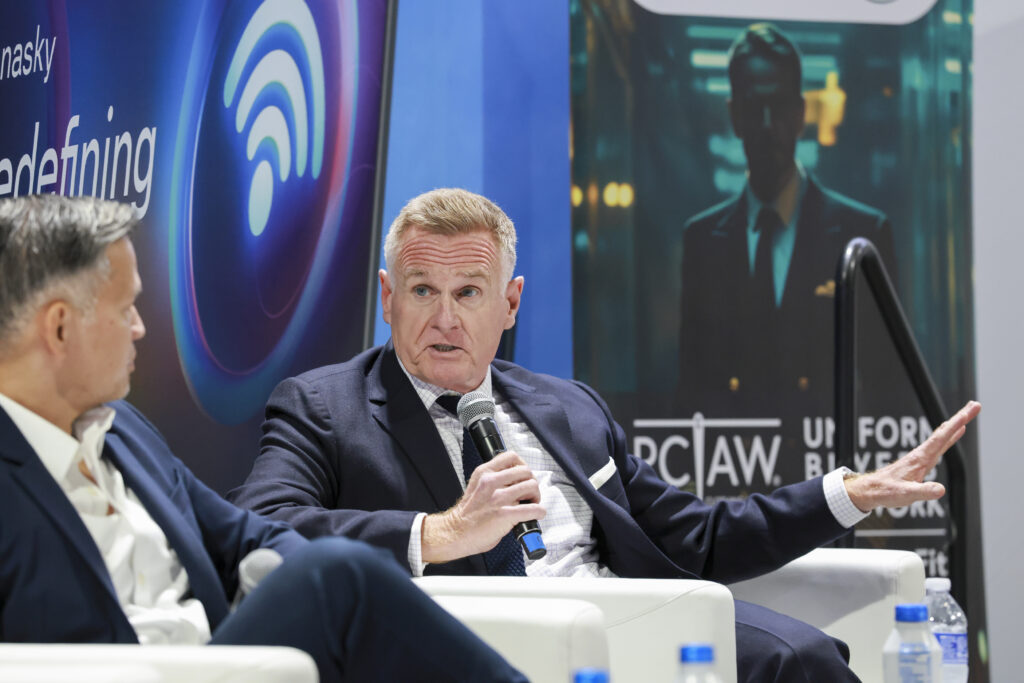
Sony VP Sales and Marketing Richard Ashton offered a reminder that airlines have enforced content restrictions long before digital streaming existed. He recalled a personal experience from the 1990s when he attempted to watch a DVD on his laptop during a flight. “I was on American West watching a DVD on my laptop, and the attendant snatched it away, saying I couldn’t do that,” Ashton said. “The awareness has been around for a long time.”
That vigilance, Ashton argued, carries even greater weight in today’s streaming environment where the financial stakes run exponentially higher. “Back with DVDs, it was ‘If you did a public performance of this, it’s a $250,000 fine.” He predicted penalties for unauthorized streaming could climb into the millions. “So there is a very sizable risk. Hopefully the industry is savvy enough to navigate this.”
Ashton stressed that just as airlines once enforced DVD restrictions to preserve rights, they must now establish firm boundaries for streaming. Clear communication and strict adherence to licensing rules can prevent exposure to costly fines and protect trust between passengers and airlines.
Paramount Pictures VP Theatrical Sales Vince Cruz reinforced that the industry has navigated technological transitions before without triggering antitrust concerns. “If we go back in a time machine, we’ve evolved from 16 millimeter to main screen tapes to DVDs and now digital systems, namely AVOD, and when a new platform presents itself it will require a new licensing model,” he stated. “In all the years that we’ve had systems and these licensing models, there hasn’t been any antitrust issues, and that’s because any discussions we have, we always include an antitrust attorney.”
Connectivity as a Creative Catalyst

The studios largely agreed that connectivity, when properly licensed, can unlock new passenger experiences and fresh ways to highlight brands.
Hill pointed to a hybrid model that blends streaming with edge caching. “We’ve heard from our airline partners that we could have a symbiotic relationship between streaming and edge caching […] I think it’s going to solve some of the problems related to rights and help airlines with net promoter scores.”
BBC Studios SVP Out of Home & BBC News Commercial Development Zina Neophytou noted that connectivity already allows BBC News to offer live programming, something no other BBC channel currently permits. “Connectivity has opened up a lot of doors for us,” she said.
Beyond live news, she pointed to the speed advantage of edge caching. “If a BBC show is broadcast today and it’s available tomorrow, that’s a fantastic USP, getting content onto airlines much quicker.”
“Connectivity has opened up a lot of doors for us.”
– BBC Studios SVP Zina Neophytou
She recalled a high-profile partnership with Emirates to simulcast Seven Worlds, One Planet. “Every Sunday at six o’clock, Emirates passengers watched the latest episode alongside its premiere in the UK,” Neophytou explained. That collaboration ran for seven weeks, underscoring the potential of connectivity to bring global audiences together in real time.
Cruz highlighted another success story involving Paramount+ and Delta. Passengers accessed streaming content through the carrier’s free in-flight connectivity, surprising and delighting them while also encouraging trial sign-ups for the platform. “It’s great brand awareness,” Cruz said. “We have deals with a number of different airlines, and all the branding is different, but it resonates with customers.”
He added that Paramount+ integrates closely with its airline partners’ systems, with security teams ensuring each deployment protects content rights. “Paramount+ will write code to protect our airline rights.”
Educating Airlines on Their Responsibilities

Although panelists agreed that APEX should take a central role in building alignment on streaming rights, Ashton emphasized that CSPs play a vital role in guiding airlines.
“CSPs play a very important role in guiding their clients to be compliant within the live space. To let it go unchallenged on the assumption of misinformation or misunderstanding could be catastrophic,” he argued. “The studios have very close relationships with the CSPs, so it’s not like we’re dropping a bombshell on them, but the challenge of the CSPs is they’re going to have a lot of pressure from their clients […] and they need to be doing the right thing so as to not let their clients fall into the wrong space.”
Airlines, he implied, may rely too heavily on assumptions or passenger expectations if CSPs fail to reinforce best practices. Misinterpretation of streaming rights could create financial exposure and legal disputes far beyond the scale of past IFE challenges.
APEX as the Standard-Bearer
Cruz reiterated that industry-wide cooperation within the bounds of antitrust law requires APEX’s involvement. “APEX must encourage the hardware and connectivity partners to have discussions with the content providers to make sure they’re asking the right questions.”
Dr. Leader reminded the audience of a historical precedent: APEX created a special Region 8 DVD code exclusively for airline use. “If you had a DVD that was authorized only for inflight use, the only DVD systems it would ever work on would be onboard aircraft,” he explained. That solution gave airlines and content owners a clear, enforceable path forward in the physical media era.
“APEX will be hiring a Director of Knowledge Development focusing heavily on this area.”
– APEX Group CEO Dr. Joe Leader
Building on that foundation, Dr. Leader announced that APEX will establish a new Director of Knowledge Development role to address streaming rights more directly. “APEX will be hiring a Director of Knowledge Development focusing heavily on this area,” he revealed. “Our job is to combine perspectives from studios, CSPs, airlines, and connectivity providers, and provide the guidance the industry needs.”
With this step, APEX signaled that it intends not just to host dialogue but also to create actionable frameworks, technical standards, and educational resources, all within the bounds of antitrust law. This new function may help transform the fragmented discussion around streaming into a clear roadmap for airlines, content owners, and passengers alike.
A New Era for In-Flight Entertainment
The session at APEX EXPO highlighted both the challenges and opportunities of streaming at altitude. Studios demonstrated that in-flight licensing remains central to revenue protection and creative sustainability. Airlines face pressure from passengers who increasingly equate connectivity with full streaming rights. CSPs sit in the middle, responsible for guiding clients through complex rules.
APEX’s historical success with Region 8 DVDs provided a reminder that antitrust compliant industry collaboration can produce durable solutions. STREAM (Standardized Technical Rights Enforcement for Airline Media) and the new Director of Knowledge Development role aim to carry that legacy forward into the digital era.
The discussion made clear that the path ahead requires compromise, innovation, and vigilance. By acknowledging the realities of licensing while embracing connectivity’s creative potential, the industry can chart a course that satisfies passengers, protects rights holders, and avoids costly disputes.