


Connecting China’s Consumers: Will In-Flight Smartphone Usage Spur Onboard Retail?

Share
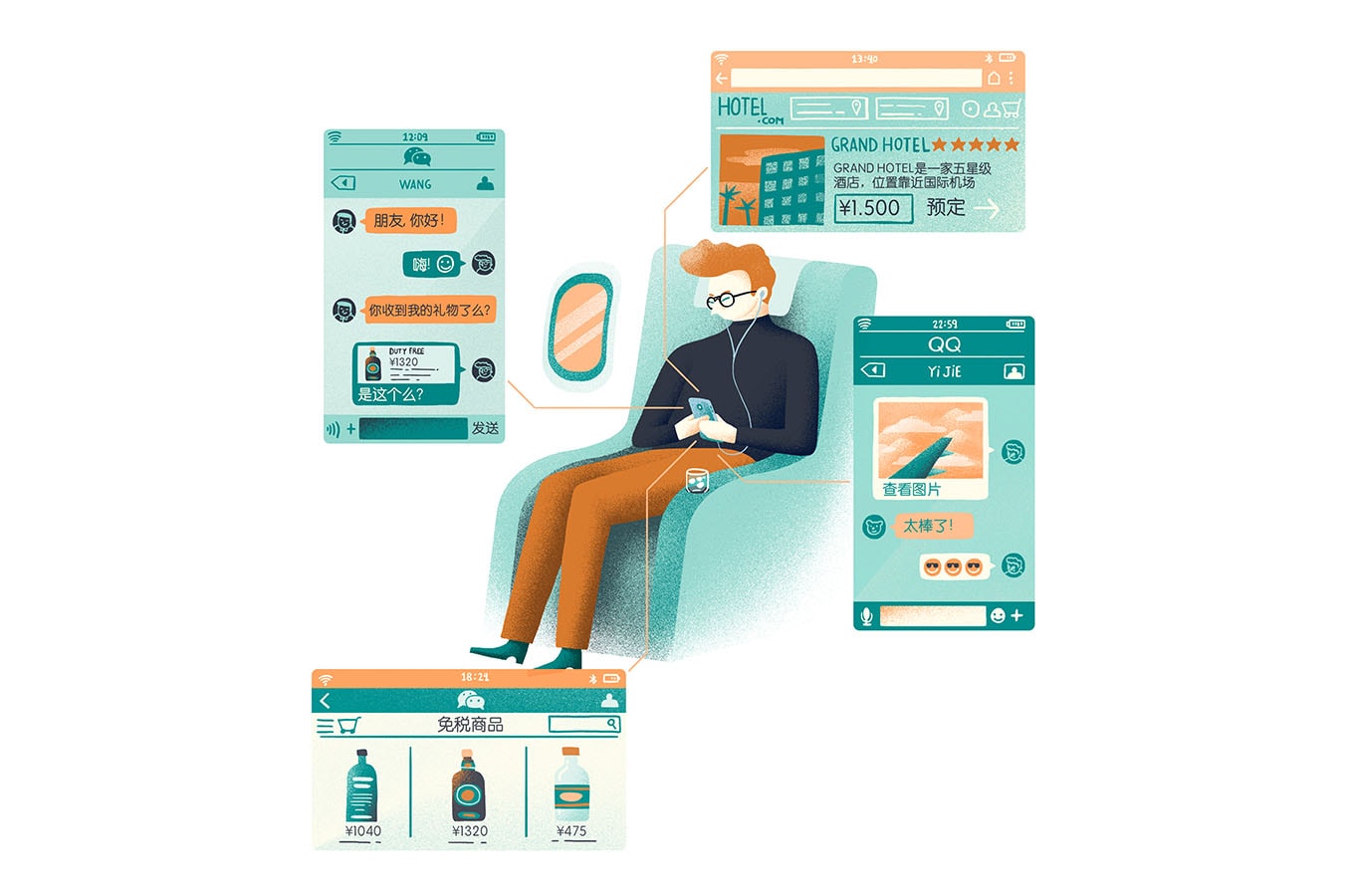
APEX Insight: China has loosened its grip on in-flight smartphone usage. Will airlines reap the benefits?
The use of smartphones, once banned on aircraft by Chinese government regulators, has only recently been permitted. After receiving approval from the Civil Aviation Administration in China (CAAC), domestic airlines will have to decide how to meet passengers’ usage demands, ushering in an era of change for in-flight connectivity (IFC), which may finally mirror the country’s connectivity experience on the ground.
Smartphone usage rates in China are higher than they’ve ever been, with nearly 731 million – 53 percent of the population – using mobile Internet as of December 2016, according to China Internet Network Information Center. And it’s for more than just communicating. With 74 percent of all online payments completed on mobile devices in 2016, smartphones are the cornerstone of the shopping experience in China and, perhaps soon, the airspace above it, too.
Data traffic from Chinese users is consolidated into fewer apps than in other parts of the world. Multifunctional social media platforms are the driving force, with WeChat and QQ leading the charge. These apps integrate shopping channels and facilitate sharing just as much as consumption of data, creating a capacity challenge for IFC service providers.
Traditional commercial aircraft IFC solutions skew heavily toward bandwidth delivered to the aircraft versus headed to the ground, and that “limits how global satellite platforms can be adapted for Chinese IFC,” says Global Eagle’s executive vice-president of Connectivity, Joshua Marks. And with upstream demand from Chinese smartphone users expected to increase, mobile usage in flight will need to be offset with more onboard revenue opportunities. Rather than using customer access fees to cover the total cost of connectivity, airlines could look to sponsorships and shopping to bring in additional revenue. “Onboard retail will be a primary driver of IFC adoption, driven by airline-specific retail programs and access to third-party e-commerce apps,” Marks says.
“The onboard wireless server has many advantages for commerce.” – Joshua Marks, Global Eagle
Marks is excited about the opportunity to leverage existing merchant systems for in-flight retail experiences over China. “The onboard wireless server has many advantages for commerce: low latency, targeting capability and virtually unrestricted capacity for product views or videos,” he says. “Particularly in China, we’ll see more capacity on wireless servers reserved for retail applications alongside traditional streaming video on demand.”
However, regulatory and economic challenges will remain, even as mobile device usage is adopted in flight. The CAAC typically issues only one-year trial licenses for service, making long-term investments in infrastructure risky. Bandwidth costs are also relatively high, with limited satellite capacity focused on the busy east coast travel corridor and government requirements that data be handled by ground stations in China.
Addressing these issues will reduce uncertainty around the market – uncertainty that has multiple vendors suggesting current investments in the region are lower than they could be. Clarity on policy long term and access to a stable revenue environment will spur the capital investment needed to bring the Chinese IFC market on par with, or beyond, the rest of the world. Openness to IFC and merchandising will drive that agenda forward; hopefully Chinese regulators smooth the shift.
“Connecting China’s Consumers” was originally published in the 8.1 February/March issue of APEX Experience magazine.