


Customers of Height

Share
Recent knee defender-spurred reclining incidents are evidence of the fact that airlines, seat designers, and passengers don’t have much wiggle room to work with when it comes to seats in the cabin. In October’s Journey issue, a roundtable of experts discuss comfort in the cabin, tackling the tough issue of accommodating “customers of size.” Not to be forgotten, we look at “customers of height.”
Popliteus and Percentiles
Seat and furniture designers rely on measurements collected by organizations such as the Civilian American and European Surface Anthropometry Resource (CAESAR), compiled in 2000 by the Society of Automotive Engineers (SAE), or BIFMA, a non-for-profit trade association for business and institutional furniture manufacturers. After collecting measurements from civilians, CAESAR and BIFMA organize their data into averages and percentiles; CAESAR’s most recent report accounts for the 95th percentile, that is 95 percent of the population surveyed, and BIFMA accounts for 90 percent.
Checks are in place to try to account for the disparate (long and small) measurements, but as SitOnIt Seating asks,
“No matter how it is designed and engineered, is a chair suitable for a 6 foot, 2 inch, 256-pound male (95th percentile) also suitable for a 4 foot, 11 inch, 113-pound female (5th percentile)?”
When it comes to height, there are three measurements of particular importance in seat design: the distance from the buttock to the anterior (or outside) point of the knee [A], the distance from the buttock to the popliteal (inside of the knee)[B], and the height of the knee [C].

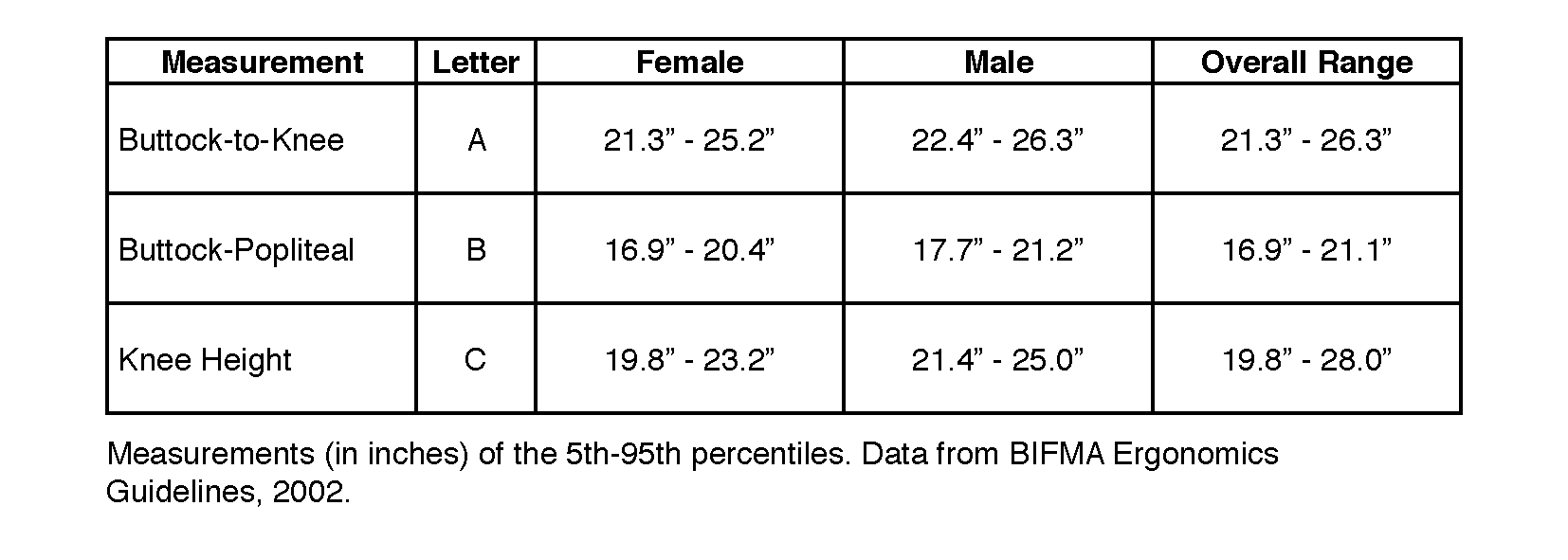
According to SeatGuru, the average seat pitch, a technical term referring from the distance between the back of a passengers seat and the back of the distance in front of them, is 30 inches. Within BIFMA’s overage range for buttock-to-knee measurements, that leaves the smallest measuring passengers with a comfy 8.7 inches of space between their knees and the next chair and the tallest with much less wiggle room, with approximately 3.7 inches.
At the same time, seat designers that factor in the ergonomic advice provided by organizations like BIFMA and CAESAR are constrained by the buttock-popliteal measurement, which is used to determine how long the depth of a seat should be. According to BIFMA, a chair user should be able to sit with their back against the backrest and still have space between the edge of the seat and the back of the knee. In order to account for BIFMA’s suggestion, the seat cannot have a depth measuring greater than the smallest buttock-popliteal measurement, which in this case is 16.9 inches.
Great or Small, One Size Fits All
Accounting for all passengers great and small in a “one size fits all” cabin seat is no small order. Increasing the seat pitch by moving chairs farther apart would undoubtedly improve cramped conditions for tall passengers but several other constraints, namely economic ones, usually result in an architecture of compromise.