


In-Flight Wi-Fi Availability Approaches 50% According to Routehappy Report

Share

APEX Insight: The chance that a commercial airline passenger will have access to in-flight Wi-Fi is 43%, according to Routehappy’s 2018 Wi-Fi Report, released yesterday at APEX TECH. The availability of in-flight connectivity that offers an experience comparable to at-home Wi-Fi increased 129% since last year, and Netflix wants to know which flights offer the best quality connection.
“Where are we with in-flight Wi-Fi?” asked Jonathan Savitch, Routehappy’s chief commercial officer, at APEX TECH yesterday as he presented the results of Routehappy’s 2018 Wi-Fi Report. In-flight connectivity is “fast becoming the norm,” he continued. Eighty-two airlines worldwide now offer in-flight Wi-Fi, 12 more than this time last year, according to the report.
Routehappy’s research indicates that 43% of available seat miles (ASMs: the number of seats for sale multiplied by the number of miles flown) offer in-flight connectivity that is partially or fully rolled out. This represents a 10% increase compared to last year’s report.
In other words, there is more than a four-in-10 chance that a commercial airline passenger will have access to in-flight Wi-Fi. “It’s fast approaching 50%,” Savitch said. “Two years ago, there was only a one in three chance you would board a flight with Wi-Fi.”
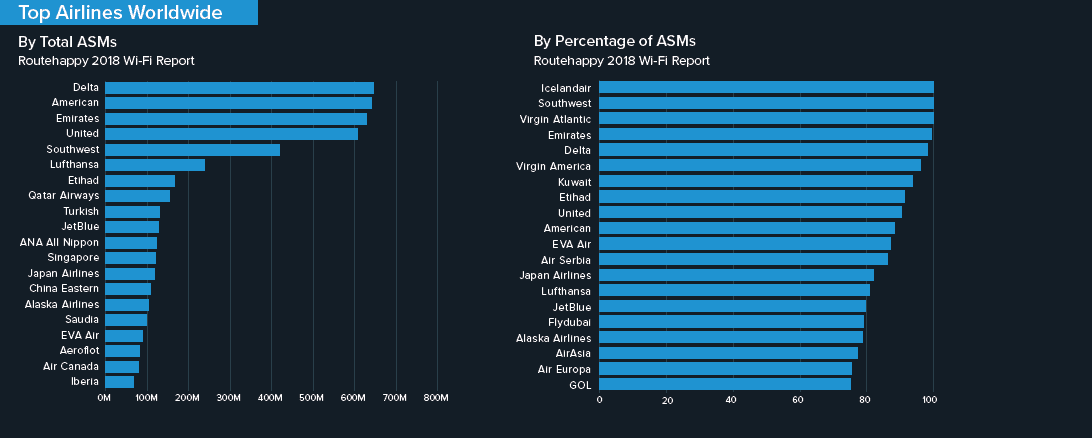
Moreover, the report shows that 13 airlines now offer Wi-Fi on all their flights. Put in perspective this is up from seven airlines in the 2017 report, and only one the year before that.
Connectivity on US flights, Savitch explained, has almost reached “the point of saturation.” Measured in total ASMs, 86% of US carrier flights now offer full or partial Wi-Fi coverage, while non-US airlines are farther behind in their connectivity offerings. Even so, Savitch claimed that market leadership is no longer exclusive to US airlines, citing Emirates’ rollout of Wi-Fi on its Boeing 777s last year and Lufthansa’s rollout of Inmarsat’s hybrid satellite and LTE-based European Aviation Network connectivity on its narrow-body fleet: “When we look at this from a long-haul perspective, we see where the next battleground is. Emirates has the lion’s share. They’ve got more available seat miles for Wi-Fi than United and Lufthansa combined.”
“[Netflix] wants to know which flights have the best Wi-Fi.”
“The quality of in-flight Wi-Fi is getting that much faster, ” noted Savitch, explaining that availability of the best Wi-Fi has increased 129% since 2017 alone. Routehappy’s report divides Wi-Fi quality into best, better and basic categories. It defines the “best” Wi-Fi as satellite-based Ka- or Ku-band connectivity that offers “something equivalent to home streaming.” Meanwhile, deployment of basic services has dropped by 16% in the same timeframe.
Will this rate of change be sustained in the coming year? “The pace going from basic to better to best is much faster,” Savitch said. “Next year I think we’ll be talking more about the best experiences.” Routehappy has entered a data-sharing partnership with Netflix because the streaming service “wants to know which flights have the best Wi-Fi. How that data is it being used, will be a question next year.”