


Flights of the Engineers

Share
 Airplanes are taking off and landing at Phoenix Sky Harbor Airport at regular intervals, but Honeywell Flight Test Operations staff at the runway-adjacent site, are unphased by them. When talking to each other, the team makes obligatory pauses to account for the roar of a jet engine taking off, and then resumes conversation. Take-offs and landings reverberate through their language like punctuation.
With its Deer Valley facility for avionics, Honeywell Aerospace Engines Facility (where its industry-renowned auxiliary power units are produced) and its headquarters all located in Phoenix, Arizona, it’s also a prime place for Honeywell’s Flight Test Operations team. Except for all that good weather. Why would that be bad? Well, among many other things, the 757 flight test team are a bunch of storm chasers of sorts. “Hey, we’re uh, we’re experimental,” says flight test engineer Ian Bell, coyly.
This year will mark the 50th anniversary of flight test operations at Phoenix Sky Harbor Airport where various aircraft have served as flying testbeds over the years. In 2003, Honeywell went on the search for an aircraft to replace the 720B that had been acquired 16 years earlier to test turboprop and turbofan engines. The Boeing 757 was ultimately selected because, among other reasons, its flight control system was more adaptable to envelope-pushing testing than the other aircraft. Bell explains that, “Key requirements were a large flight envelope, in terms of low and high speed at high altitude – with 45,000 feet being a guaranteed requirement for our internal and external customers.” It’s also really big, and for the kind of flight operations Honeywell conducts, size does matter.

Fifth off the assembly line, and having taken its first flight 32 years ago on Februray 4th, 1983, the Boeing 757-225 N757HW is a tried-and-true, workhorse of an aircraft. It flew with Eastern Airlines for eight years before being withdrawn from use at McCarran International Airport in Vegas, and delivered to Honeywell in 2005. In addition to the two Rolls Royce RB211-535E4B37 turbofans, the aircraft carries a third engine on the right side of its forward fuselage. “When we originally modified the airplane, we made it so that we would be able to test any engine that Honeywell is likely to produce in the next 30 years. That structure is quite good for a large engine, so we won’t need to modify the airplane twice,” Bell explains.
The aircraft underwent an extensive modification program, forming a bricolage-like assemblage of parts taken from different places: an airframe from MyTravel, a paint job at Pinal Airpark. Even the seats in the front cabin – there’s only four of them – have of hodgepodge story behind them: “We traded a set of brakes and wheels from the old airplane for some Delta seats,” chief test pilot, Joe Duval explains with a zeal comparable to that of a kid who up-traded his recess snack at school. Duval’s logged over 7,000 hours of flying time as a pilot and flight engineer and has flown commercially, privately and for the United States Air Force – an avgeek in the truest sense.

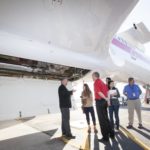
Duval explains the setup on the 757 testbed is primarily to do engineer propulsion flight testing, “The engines that we make are primarily what we test here, that’s why we’re collocated with the [Honeywell Aerospace Engines Facility].” But the operations team takes advantage of every test flight to trial other Honeywell products, like airborne weather radar systems. “The weather radar is probably our second customer, behind propulsion activity,” Duval explains. Because of its sheer size, the 757 can support multiple projects in the same flight.
A standard flight test crew consists of a pilot, copilot, flight-test engineer, controls engineer, project engineer and two data monitoring instrumentation technician. “We typically do several hundred hours of flight testing, depending on the nature of the engine,” Bell explains. “And, of course, we’re also doing other tests: radar tests, flight management systems, Required Time of Arrival – stuff that Honeywell makes, we can fly.” The ability to test their own products on the flying testbed, allows for a more ready dialogue between the development teams and the perceived end users.
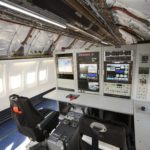
The flying testbed also allows Honeywell to demonstrate its products for its customers – which is way cooler than showing up with a one-sheet with specs on it. “It does have a cool factor, I’m not going to deny that,” admits Duval.
Read our feature on Honeywell, “Ahead by a Century,” in The Technology Issue.