


Hub and Bespoke
Share

This article originally appeared in The Education Issue of APEX Experience.
Hamburg was strongly affected by World War I and completely devastated in Allied bombing raids during World War II. Yet the city, its people, and its economy have subsequently not only persevered but excelled. Today, Hamburg is a municipality of over 1.8 million people (with the purchasing power of any German settlement) and is currently ranked as the third largest worldwide site within the aviation sector, after Seattle and Toulouse.
Hamburg’s Aviation History
Hamburg’s first airstrip was built in 1911 in the city’s Fühlsbuttel district. Scheduled flights by the world’s first passenger airline, DLR (Deutsche Luft-Reederei, or German Air Transport Company), commenced there in 1919.
Global recession affected aviation and many of Hamburg’s other business sectors in the early 1930s, including the city’s main industry: shipping. Convinced that aircraft would very soon traverse great distances of water, shipping magnate Walther Blohm created Hamburger Flugzeugbau (Hamburg Aircraft Construction) and incorporated it as a subsidiary of his shipbuilding and engineering works, Blohm & Voss. Located at the current site of Airbus’ completion center and airstrip in Finkenwerder, Hamburger Flugzeugbau manufactured a number of notable aircraft including large “flying boats” which had no landing gear and a hull-like fuselage for water takeoff and landing. In the 1930s and 40s, this location also produced warplanes for Hitler’s Third Reich.
In the aftermath of World War II, Hamburg’s industrial areas and transportation networks lay in total ruin. However, the airport was swiftly re-built and within a decade things were getting back on track. “1955 was a very distinctive year for the German aviation industry and also for the Hamburg aviation industry,” explains Uwe Kleber, aviation cluster management at Hamburg Ministry of Economics, Traffic and Innovation. “Lufthansa was re-founded and Hamburger Flugzeugbau resumed the construction of aircraft in Finkenwerder with the HFB 320 business jet.”
“Without aviation I think Hamburg would be in a very different place than it is today.” -Uwe Kleber, Hamburg Ministry of Economics
Ode to Airbus
By the 1970s globalization had caused much of the world’s maritime business to shift to Asia. Hamburg responded to this downslide of one major industry by focusing more energy into another. In 1969 the Airbus program launched with French and German participation, and Finkenwerder became its home in Germany. The following year, the Hamburg University of Applied Sciences instated “Aircraft Construction” as a new degree program, and by 1971 large structural elements for the A300 were being produced in the shadows of towering ship cranes on the banks of the Elbe River. “Without aviation I think Hamburg would be in a very different place than it is today,” Kleber admits.
Twenty years later, in 1992, final assembly work for the A321 began in Finkenwerder. The A319, A318 and A320 were soon added to the list of Airbus aircraft completed or partially assembled in Hamburg. The infrastructure and talent pool (not to mention political support) that grew up around Airbus’ early programs (and Lufthansa Technik’s growing influence) cemented Hamburg’s role as a power-player in global aviation and contributed to the selection of the Finkenwerder site as a completion center and paint shop for the famed A380 jumbo jet.
An Expanding Workforce
At the turn of the millennium roughly 14,000 people in the Hamburg metropolitan area earned their wages from the aviation trade. Officials had then estimated that the newly launched A380 program would add another 4,000 to this sum, but A380 completion actually brought that total up to 26,000 jobs. Today, just seven years after the first of the giant birds was delivered to launch customer Emirates Airlines, Hamburg’s aviation sector boasts a workforce of 40,000 men and women – and that number is quickly rising.

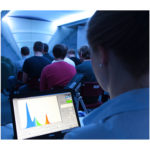
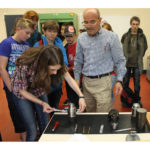
“Hamburg recognized at a very early stage that education and joint development of expertise were central drivers for the economy and in 2000 founded the Aviation Industry Qualification Initiative,” explains Ingrid Schilling-Kaletsch of Hamburg’s Ministry of Economy, Transport and Innovation. “When Hamburg decided to apply to be the final assembly line site for the A380, there was a clear need for qualified personnel. This effort was not initiated by the ministry of education. The ministry of economics had the responsibility to develop these programs because ultimately they needed to meet the needs of the industry.”
Schilling-Kaletsch was selected to develop a plan that would bring the industry together with educational institutions and the physical equipment needed to train a bigger and brighter talent pool in the region. Together with the head of Hamburg’s University of Applied Science (HAW), a vocational college renowned for its outstanding Aeronautic Engineering program, Schilling-Kaletsch hatched an idea to develop the Hamburg Centre of Aviation Training (HCAT).
Centre of Aviation Training
Built in two stages between 2006 and 2011, HCAT is located next door to HAW and also stands beside Berliner Tor station, a well-connected point on Hamburg’s extensive local and regional train network. Here, students of aeronautic engineering receive instruction on either engineering for cabin and cabin systems or aircraft design and lightweight structures, depending on their personal educational directives.
The facility is 32,292 square feet (3,000 square meters) of classrooms, workshops, test rigs and laboratories. It very effectively brings industry partners Airbus and Lufthansa Technik into direct and constant contact with students and educators. The industry speaks and HCAT responds. “If there is a special demand from the industry, we can realize special courses for it,” says Schilling-Kaletsch. “We have installed the infrastructures that allow both practical work and theoretical study.”
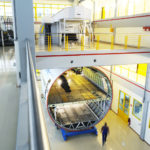

While dozens of professors from HAW use the center, four of them are more or less “resident.” One of these individuals is Mark Wiegmann (formerly of Airbus), who specializes in electronic cabin systems and system design. “Practical insight and experience are not usually found in textbooks,” he says. “Clearly [students] must learn all the skills of an engineer, but they also should know how things are actually done. I can tell the difference, having studied at and finally received my doctorate degree in electrical engineering from a ‘regular’ university. Currently, I think we are more or less unique with our [Cabin and Cabin Systems] lab in the world… but I would take a bet that there are plans somewhere, inspired by our work, to outperform us.”
“Clearly students must learn all the skills of an engineer, but they also should know how things are actually done.” -Mark Wiegmann, HAW professor
HCAT does not target university-age students alone, but also offers continuing education programs to individuals already employed in local aviation. Special considerations have also been made that allow some of these mature students to continue working as they earn a higher degree – something not possible before. Additionally, HCAT runs workshops reaching out to parents and children as young as eight years old. “Professors develop special lectures for the children at the university, which are at their level and presented in a fun way,” says Schilling-Kaletsch. “And we want to inform parents too, about the fascinating possibilities the aircraft industry can offer their children.”
Read the extended version of this article here.