


MIT and the Future of Air Transportation

Share
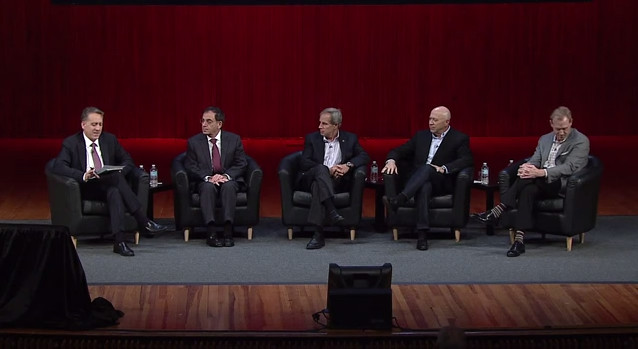 With long manufacturing lead times and a low economic tolerance for risk, the aerospace industry, backed by research from MIT and other think tanks, has turned soothsaying into a pseudo-science. As Pat Shanahan, MIT alumnus and senior vice-president and GM of Airplane Programs for Boeing quips, “The things people are involved in today at MIT are the things we’ll be doing at Boeing tomorrow.”
So, to celebrate the milestone of 100 years of aerospace research at MIT, a panel of experts – consisting of MIT faculty and alumni who now hold prominent positions in the industry – gathered for the MIT AeroAstro Centennial Symposium to foretell what they think the aerospace future will hold.
FLYING IN THE FACE OF RISK
Despite the acuity with which the aerospace industry predicts the future, a low economic risk tolerance persists among OEMs. According to Hansman, “The system is so good that if you want to do something innovative and change, it’s actually hard to do… Particularly in the situation we have today where there’s effectively a duopoly between Boeing, Airbus and some other players, it’s actually hard for anybody to really take the risk to go out and do something different.”
Shanahan points out that Boeing’s 787 Dreamliner was a risk by today’s standards, and Hansman concedes but insists that economic rivalry prevents true potential from being realized: “If it takes you 10 years to make an airplane, and you’re out of the market and your competitor’s doing it … you lose. So there’s this incentive right now, to do enough to stay competitive, but it’s hard to shoot for the home run.”
EXPANSION IN THE EAST
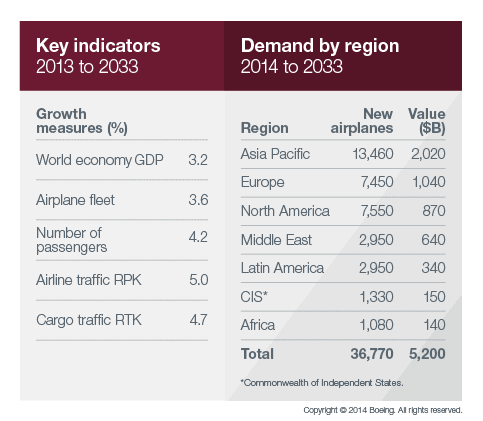
Among the predictions made by the panel, Shanahan forecasts that the current global rate of 70,000 takeoffs per day will more than quadruple to 300,000 takeoffs by 2030. Panelists agreed that growth is going to be enormous, particularly in developing parts of the world. “We know that the amount of air transportation activity effectively correlates with GDP or economic activity. So if you look at where economic activity is going to grow around the world, and where there’s lots of people – places like China, India, South America, we do expect huge growth globally in air transportation,” Hansman explain.
70,000 takeoffs per day will more than quadruple to 300,000 takeoffs by 2030
China particularly will be a forerunner of growth: “One of four aircraft [manufactured by Boeing] goes to China. They’re building 37 airports right now,” adds Shanahan. The challenge posed by this growth is finding effective ways to accommodate for it globally without compromising efficiency and safety of global air transportation system.
FEELING THE FUEL BURN
Global commercial growth may be good for the industry, but it’s bad for the environment. Huge improvements have already been made: “65 years since the first 707 entered commercial service here in the US, we’ve reduced the fuel burn by 70 percent,” Alan Epstein, vice-president of Technology and Environment for engine maker Pratt & Whitney notes.
But these advances need to keep apace of aviation’s environment enlarging environmental footprint. Atmosfair’s recently released 2014 Airline Index found that while the largest airlines in the world have decreased their CO2 emissions by approximately 1 percent per passengers and kilometer, the total CO2 output his risen by 3 percent as a result of growing flight volumes.
Epstein says the question the industry will face is: “How do we continue to deliver the improvements in economic performance with commercial aircraft, but meet the new environmental challenges?” With fuel representing as high as 40 percent of an airline’s running costs, airlines already have a strong economic incentive to improve fuel efficiency, and Epstein remains convinced that a solution will be found.
By 2016, 1% of all jet fuel could be provided by bio sources.
In another panel, John Tracy, chief technology office at Boeing shared that, “By 2016, 1 percent of all jet fuel could be provided by bio sources,” adding, “We believe it could be cost competitive by 2020.”
AUTO-PILOTING THE FUTURE
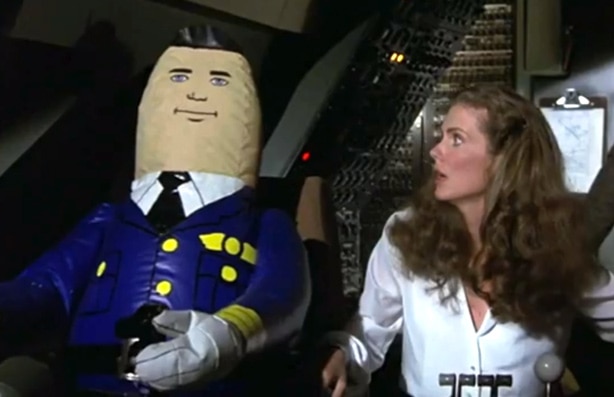
According to Jeff Katz, founding CEO and chairman of travel-booking company, Orbitz, another opportunity to reduce costs in the future is to reduce – or even eliminate – pilot crews. “Fewer pilots per airplane is really on the minds of airline executives today, but [it is] not much talked about.” Katz thinks primary obstacle in reaching this future is more of a marketing one than a technical one. Shanahan agrees, “I think all of us recognize that airplanes can fly by themselves, they do it all the time. How we overcome social concerns, or regulatory concerns, I think collectively we’ll be able to work through that.” We won’t see auto-piloting in our generation, but as soon as our children’s generation Katz predicts.
A HOLISTIC JOURNEY
Most of the panel has agreed that commercial air travel has come so far that it’s actually the disparate ends of the passenger journey that could stand to see some improvement. “Aren’t we at the point now where the airport experience is the most negative part of the entire trip?” gibes Epstein, to an outburst of applause. Katz agrees that finding a way to take hours out of the trip that happens “in the airport, on the way in and on the way out,” would be “huge for experience.”
But as one audience member noted, finding a way to connect all elements of the passenger experience is easier said than done, especially when institutions like MIT, NASA and Berkeley still operate in a somewhat siloed model. Hansman concedes that there’s room for improvement, but reassures MIT and others are starting to move towards a more holistic approach: “We’re trying to move that way, but it’s also often hard to get people to fund research that’s cross-modal.”
See the full video and more from the conference below:
Watch full video series from MIT AeroAstro Centennial Symposium.