


Sporting Airlines
Share

This article originally appeared in The Culture Issue of APEX Experience.
With seven minutes remaining during the final 2014 FIFA World Cup match, Deutschland’s André Schürrle breezed past three Argentina defenders, sent the ball in from the left flank to the near post where teammate Mario Götze received the ball on his chest, took one touch and beat the goalie with a volley to the far post, scoring the big win for Germany and sending fans around the globe into a World Cup frenzy.
EMOTIONAL APPEAL
Ask any football (soccer, in North America) fan to describe that World Cup moment and that person is more likely to tell of the emotions he or she felt as that soccer ball hit the net than the details of the play. And unless that fan has an excellent visual memory, chances are, if asked today, he or she wouldn’t remember the big red and white “Fly Emirates” banner plastered on the stadium wall that flew across the TV screen as the winning goal was scored.
A recent study published by the Journal of Sport Management analyzing the relationship between team loyalty, sponsorship awareness and attitude toward the sponsor brand found that fans’ attachment to their team translated into a positive disposition toward the team sponsor. The study also found that fans who reported higher game attendance were more likely to recall a brand as a team sponsor.
The Gulf carriers account for a bit over half of global airline sponsorship spend, with Emirates being by far the biggest.
– Simon Rines
Whether spectators were aware of the Emirates banner or not, the airline logo was present during a moment of great emotion for the thousands of fans filling the stadium, as well as for the more than one billion people around the world watching that day. And when brands such as Emirates align themselves with sports teams through multi-million dollar sponsorship deals, ultimately, brands such as Emirates are using the emotional impact of sport to connect with fans. “[Sponsorship] is tapping into key passion points,” says William Chipps, senior editor of the IEG (Independent Evaluation Group) Sponsorship Report. “So you see companies sponsor everything from sports to music to the arts, making that emotional connection with consumers.”
SPONSORSHIP SPEND
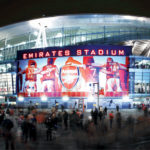
Although airlines are involved in sponsoring music and the arts, because of the global popularity of sports, and football in particular, sports sponsorship is where the overwhelming majority of investments by airlines is made, with the heftiest spending coming from the Gulf region. “The Gulf carriers account for a bit over half of global airline sponsorship spend, with Emirates being by far the biggest,” says Simon Rines, managing editor at UK-based sports business analyst, IMR Publications.
And airlines are paying big bucks to have their logos represented on player jerseys, stadium signage and team merchandise. And though Emirates represents a large majority of sponsorship spend, other Gulf carriers are getting in on the sponsorship game as they look to build their global brand awareness.



LOFTY SUPPORT
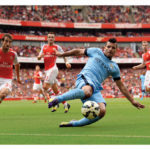
In 2011, Etihad Airways signed a 10-year sponsorship agreement worth £400 million with Manchester City Football Club, the largest of its kind in football history. In 2012, Qatar Airways signed a five-year shirt sponsorship deal with FC Barcelona worth £125 million, becoming the first corporate logo to appear on the famous jerseys. As Rines explains, the length of arrangements tends to differ. “[The duration of sponsorships] vary on the type of deal. Some of the airlines have naming rights deals, and they typically last for eight to 15 years, whereas a shirt sponsorship is usually negotiated over a three-year period.”
US carriers are also investing, albeit much less compared with Gulf carriers, totaling roughly $100 million between them annually, while Europe’s legacy carriers are trending on the side of sponsorship cutbacks. “[The Gulf carriers] do not have the same constraints that the airlines that are known as legacy carriers do, which can’t just write blank checks – they’ve got to earn back every penny,” Rines notes. And unlike the Gulf carriers, US airlines are more prone to sponsor sports in the US, rather than in other markets, with the exception of Delta Air Lines, which signed a multi-year sponsorship deal with UK football club Chelsea FC in June 2012.
FOLLOW YOUR ROUTES
According to a report in 2012 by IMR Publication Sponsorship Today, global sponsorship from the airline industry had reached $515 million per year, with Emirates representing $182 million of that spend. Rines is quick to point out, however, that the disproportion in investment is a direct result of a larger initiative to promote the Gulf regions as global tourism hubs. “The Gulf states are spending a fortune on their tourist infrastructure,” says Rines. “They’re trying to develop the Gulf areas as global travel hubs and they’re ideally placed to do that in many respects. They’re midway between Europe and the Far East, and they can be midway between the Americas and the Far East.”
With Dubai International Airport officially surpassing Heathrow as the world’s leading travel hub this past year, and Emirates crowned “World’s Most Valuable Airline Brand” for the third year in a row by British brand valuation consultancy Brand Finance, it’s safe to say that the investments in the region’s tourist infrastructure have certainly paid off.
The hefty spend on football sponsorships in particular is no coincidence, especially considering the route networks the Gulf carriers have established in regions where football is most popular. “One of the interesting things to look at is the sports that [the airlines] are following… There’s interest in [football] clubs all the way across [the airlines’] route network, which is strongest between Europe, the Middle East and Asia,” notes Rines. He also cites the example of Emirates’ significant sponsorship spend in cricket, a sport most popular in the UK, India, Australia and South Africa, all of which align perfectly with the airline’s big group network.
BRAND AWARENESS
Airlines have learned that with sports sponsorship comes increased brand awareness among business travelers. “Obviously, business travelers are important, and with sponsorship usually comes hospitality rights in the stadiums whereby [the airline] will invite the travel departments of major corporations,” explains Rines. And Emirates goes even one step further, offering its Skywards members a chance to redeem their miles for soccer match tickets starring some of the best teams in the world.
But the Gulf airlines aren’t just targeting the niche business traveler market. In fact, when it comes to sponsorships, the goal is to get your brand in front of as many eyes as possible, and what better way to do that than emblazon your logo across the jerseys of a very popular football club? It’s brilliant, really.
And though Gulf carriers are seeing rapid and strong growth in their business, with IATA reporting an 11.7 and 13.9 percent growth in traffic and capacity, respectively, in 2014, the fact is, they are relatively young compared with the legacy carriers of Europe and the US, and thus have a lot more catching up to do in terms of brand recognition. But it would seem that by associating themselves with popular sports teams and, by extension, highly photographed elite athletes with enormous followings, the Gulf carriers have found their fast-track in the branding game.