


Y-Seating? Y-not! Economy Comforts on Display at AIX
Share
An economy class seat generally must be tough and very light, easy to maintain, durable and thin (to fit in more rows), inexpensive, and finally, if possible: comfortable.
This is a tall order for a seat to fill. Yet economy class makes up the vast bulk of cabin space on most commercial aircraft so it is a market that dozens of manufacturers target. Today at Aircraft Interiors Expo, APEX paid a visit to three makers of economy seating: an upstart unveiling a totally new product, a recently acquired and re-branded veteran and a massive tier-one supplier with a vast catalogue of interior products.
The Upstart:
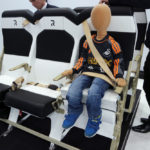
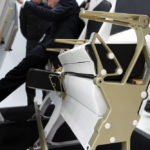
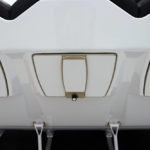
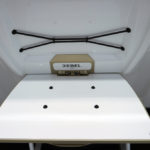


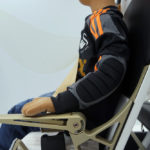
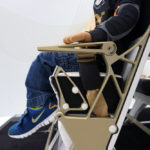
Prior to AIX, a clever marketing campaign (completely devoid of photos) from REBEL.AERO touted the company’s new short-haul economy-class seat as a revolution. Outside of claiming to improve passenger space, comfort, safety, maintenance costs and overall style, REBEL.AERO said in a pre-show release that the seat would improve boarding times while completely redesigning “the entire interface between passenger, seat and aircraft.”
Wow. We had to see this.
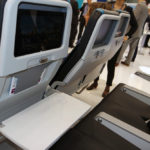
The seat does have a striking appearance to say the least, and it also introduces a few concepts that we haven’t seen.
“We wanted it to be different,” said managing director, Gareth Burks on the company’s stand. “But not different for different’s sake. It’s functional so everything does more than one job. A simple side-arm holds the armrest, pivot point, seatbelt, the attendant step and the baggage bar – all in a single piece. It’s very much form follows function. The part count is very low so maintenance is going to be quite simple.”
The seat almost looks like a cross between futuristic roller coaster and a racing car. A three-point harness has been integrated into the design – something that Burks thinks more airlines will be looking at given the recent uptick in highly publicized air incidents. He added that that the 3-point harness should help the seat pass Head Injury Criterion (HIC) testing.
Uniquely, the bottom of the seat has been designed to fold up on itself. This innovation serves a few purposes. Firstly, with the seat folded partially up, boarding and de-boarding could be made faster. Secondly, when folded up it creates a booster-seat for small children, who are of course strapped in with the 3-point harness. Finally, vacuuming the floor of the aircraft would likely be made easier with the seat in the “up” position.
The seat weighs in at just less than ten kilograms per passenger place and the slimmest part of the backrest is about 15 millimeters. Though not yet certified, Burks says the seat has passed 9g and 12g static tests.
Executives at REBEL.AERO say that designing the seat from scratch they’ve has shown the industry what can be achieved in an aircraft interior “if a clear and logical approach is applied.”
Only time will tell whether this very unorthodox concept will make it through the gauntlet of industry certification and find an airline customer.


The Veteran
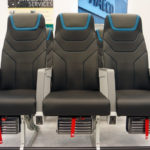
Industry veteran, HAECO Cabin Solutions, is also using AIX as a launch pad for a striking new economy-class seating range.
Though yesterday was its real “coming-out party,” the Vector range (Vector-Y for short- to medium-haul economy, Vector-Y+ for longer-haul economy and Vector-PY for premium economy) was announced internally in October 2014, and it’s been in development for about two years.
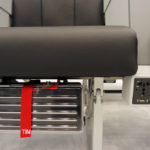
HAECO tapped Crystal Cabin Award-winning Hong Kong industrial design firm, Paperclip Designs to bring passenger-friendly elements like conveniently placed PED charging stations and an eye-level tablet holder.
New composite materials keep Vector’s weight down, while a light and innovative baggage bar adds a distinctive highlight to the seat’s appearance. Most seat components can be changed out in less than five minutes for quick maintenance, and the different Vector models share a number of common parts and consistent aesthetic. Total lifetime maintenance costs should be reduced through the use of minimal parts and components.
“A large part of our company is already focused around maintenance, repairs and operations (MRO), so we know what fails in a seat. We help our MRO customers repair and regain reliability where they’ve lost it,” said Len Kazmerski, vice-president of Marketing and Business Development at Haeco Americas. “With this seat, we have designed critical elements that typically fail in new ways that we believe will add integrity to the seat, low maintenance cost, etc. Where things are abused, for example the side bumper, we tried to make it as easy as possible to service. All of the line-removable-units on this seat are each removable in five minutes or less. That’s pretty important, especially for narrow-body short-haul operators who have short turns.”
HAECO Americas’ 120,000 square-foot production facility in Davidson County, North Carolina, has been hiring new employees to prepare for production of the Vector seating range and executives predict that Vector will continue to fuel growth at the location going forward.
The full seating platform is expected to be certified and ready to deliver as soon as late 2015.

The Giant
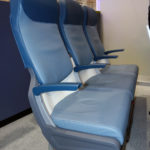
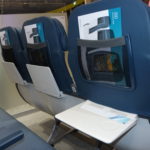
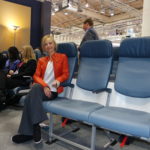
In a private section of the enormous Zodiac Aerospace booth in Hall 7, we got an opportunity to check out the Z60 economy seat for short to medium-haul aircraft. This ingenious seat made its first appearance at AIX last year as a concept, but this year it’s back a product in development.
The name Z60 is derived partially from the weight of the seat, which is just six kilograms per passenger place. The seat has a thin, ergonomically contoured backrest and relocated spreader for maximum living space.
“The main innovation is based on the fact that we use a full shell on the back, and this shell easy to clean, easy to shape and easy for installation,” explained Vincent Raffin, product manager at Zodiac Seats, France. “We are having more and more passengers in some aircraft. If you look at A321 today we have around 220 passengers and now there are requests to perhaps reduce pitch to 27 inches to have 30 more people. This seat is addressing this market when it will arrive.”
AIX conference photography: Maxim Sergienko / Raum 11