


Panasonic Avionics Expands Global LEO Connectivity Through Spacesail Partnership

Share
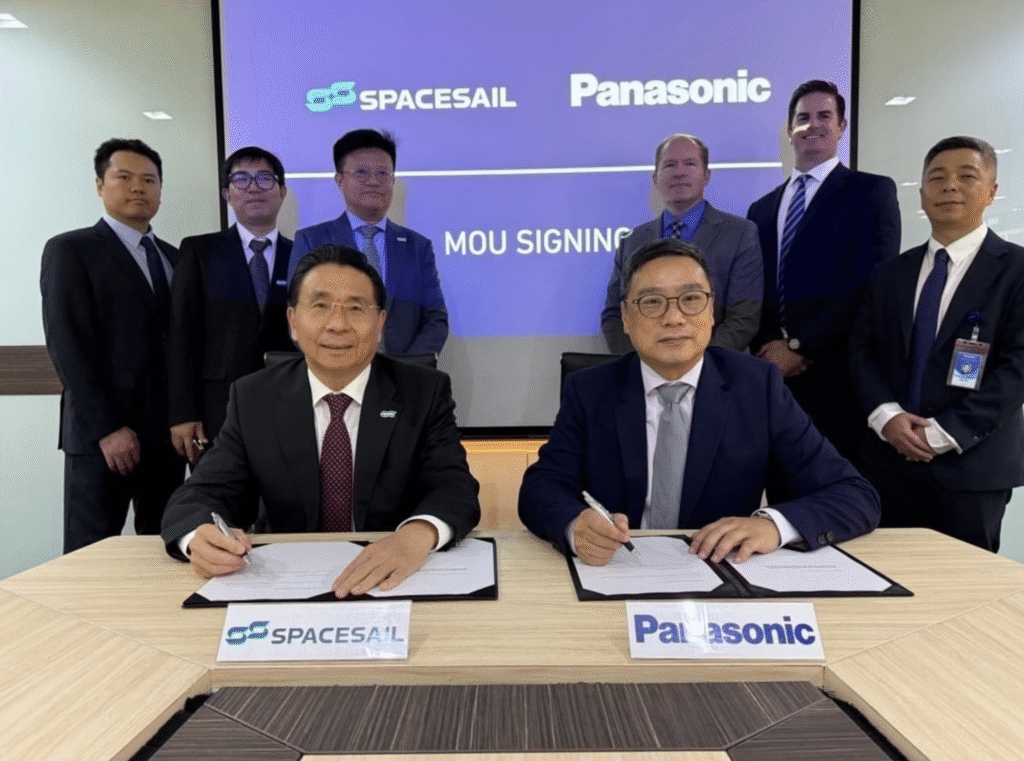
Panasonic Avionics and Shanghai Spacesail Technologies (Spacesail) have signed a memorandum of understanding to integrate Spacesail’s future low-Earth orbit (LEO) connectivity into Panasonic’s global in-flight connectivity (IFC) network. Announced at the Singapore Air Show, the agreement gives airlines access to expanded LEO coverage and strengthens Panasonic’s multi-orbit strategy. The partnership allows Panasonic to move closer to seamless global broadband performance across every region in which airlines operate.
Building a Global LEO Network
Under the agreement, Panasonic Avionics and Spacesail will immediately begin planning how LEO service will be delivered to airlines and passengers. The goal is to integrate Spacesail’s planned high-bandwidth, low-latency constellation into Panasonic’s worldwide connectivity architecture, creating more consistent performance across long-haul routes.
“Adding Spacesail’s LEO constellation to Panasonic Avionics’ portfolio will enable us to provide passengers with connectivity over every country.“
– Jon Wade, Panasonic Avionics
Spacesail holds a unique advantage as a global LEO constellation operating over China, a region that has historically presented connectivity challenges for international aviation. By incorporating Spacesail into its network, Panasonic closes a critical geographic gap and enables airlines to maintain continuous broadband service across borders.
The collaboration also reflects a broader industry shift toward multi-orbit resilience. Instead of relying on a single satellite architecture, Panasonic continues to build a layered network that blends geostationary and low-Earth orbit capacity in an approach that reduces risk, improves redundancy, and ensures performance stability even in high traffic environments.
Panasonic Avionics VP Connectivity John Wade explained the demand driving the expansion. “Airlines are demanding higher speeds, lower latency, and more resilient connectivity solutions than ever before, at every phase of flight. Adding Spacesail’s LEO constellation to Panasonic Avionics’ portfolio will enable us to provide passengers with connectivity over every country, strengthening our network and reinforcing our strategy of providing airlines with the performance, flexibility and future-proofed capability they require.”

Spacesail will complement Panasonic Avionics’ existing partnership with Eutelsat’s OneWeb LEO network, expanding available bandwidth and geographic reach. Together, these constellations form a larger network that can keep pace with aviation’s rapid digital growth.
The strategy reflects a wider industry transition. Passengers now expect streaming-quality internet access that mirrors their ground experience, as discussed during multiple sessions at the recent APEX TECH conference in LA. Airlines are responding by investing in systems that support video, messaging, real-time applications, and connected cabin services. Expanding LEO options allows carriers to scale capacity while protecting performance.
“Our joint efforts will ensure a seamless digital experience for passengers.”
– Spacesail spokesperson
This model improves resilience and performance by allowing aircraft to access the strongest available signal across multiple constellations. Airlines increasingly treat connectivity as critical infrastructure, supporting both passenger services and operational data. Multi-orbit architecture reduces risk, minimizes coverage gaps, and improves reliability in high traffic airspace.
Spacesail emphasized the passenger experience dimension of the partnership. “We are pleased to collaborate with Panasonic Avionics to extend our LEO capabilities into the aviation market. Our joint efforts will ensure a seamless digital experience for passengers, reinforcing our commitment to reliable global broadband in the skies,” a company statement noted.
Next Generation Architecture and Strengthening Leadership in Asia Pacific
Spacesail’s integration fits into Panasonic Avionics’ plan to build a next-generation antenna, terminal system, and onboard computing platform that can combine multiple satellite networks. Channel bonding lets aircraft pull bandwidth from multiple orbits and frequency bands simultaneously, creating a stronger, more flexible connection.
This setup gives airlines room to grow as passenger demand increases. Instead of replacing equipment every time a new satellite launches, Panasonic’s platform is designed to evolve with the network. Aircraft terminals act like smart routers, switching between constellations in real time to maintain stable performance. The result is a connectivity environment that feels faster, more reliable, and more responsive to passengers, while also improving operational communication between aircraft and ground systems.

The system also protects long-term investment. Airlines want technology that can upgrade over time without major redesigns. Panasonic’s open ecosystem allows new satellite partners to plug in without rebuilding the entire system, making future expansion easier.
This technology strategy supports Panasonic’s leadership in the Asia-Pacific market and beyond. The company has held a strong position in the region for more than a decade, backed by geostationary coverage over China and nearby markets through APSTAR-6D. Adding Spacesail strengthens that presence while extending Panasonic’s global reach.
The agreement also strengthens Panasonic’s role as a managed service provider within Airbus’ HBCplus program. A broader multi-orbit network increases the value of connectivity services delivered through Airbus aircraft, giving airlines integrated solutions that combine hardware, bandwidth, and operational support.