


Airbus Partners With Spacesail to Bring LEO Connectivity to HBCplus

Share

Airbus and Spacesail have announced a strategic partnership to integrate Spacesail’s advanced low Earth orbit (LEO) connectivity into Airbus’ High Bandwidth Connectivity Plus (HBCplus) in-flight connectivity (IFC) solution. Announced at the 2025 Satellite Internet Industry Ecosystem Conference in Shanghai, the agreement gives airlines an additional global IFC option built on a future LEO mega-constellation and supports Airbus’ approach of working with multiple satellite partners to provide airlines with greater flexibility and choice.
Connectivity Expansion for HBCplus
Per the agreement, Airbus will work with Spacesail to integrate its planned LEO network into the HBCplus program, giving customers another option for in-flight connectivity. This integration allows airlines to tap into Spacesail’s future high-bandwidth, low-latency constellation to enhance the passenger experience and support advanced operational services. With the deal, Airbus also aims to address growing demand from Chinese airlines for locally developed, reliable connectivity solutions.
Airbus VP and Head of the Connected Aircraft Program Tim Sommer said, “This MoU with Spacesail reinforces Airbus core strategy of building a robust and diverse ecosystem of satellite partners. By integrating the vast, global capacity of Spacesail’s planned LEO constellation, we are significantly enhancing the flexibility and choice we offer to our airline customers. This commitment ensures they can access the most advanced IFC services to meet the growing global demand for high-quality connectivity on all routes.”
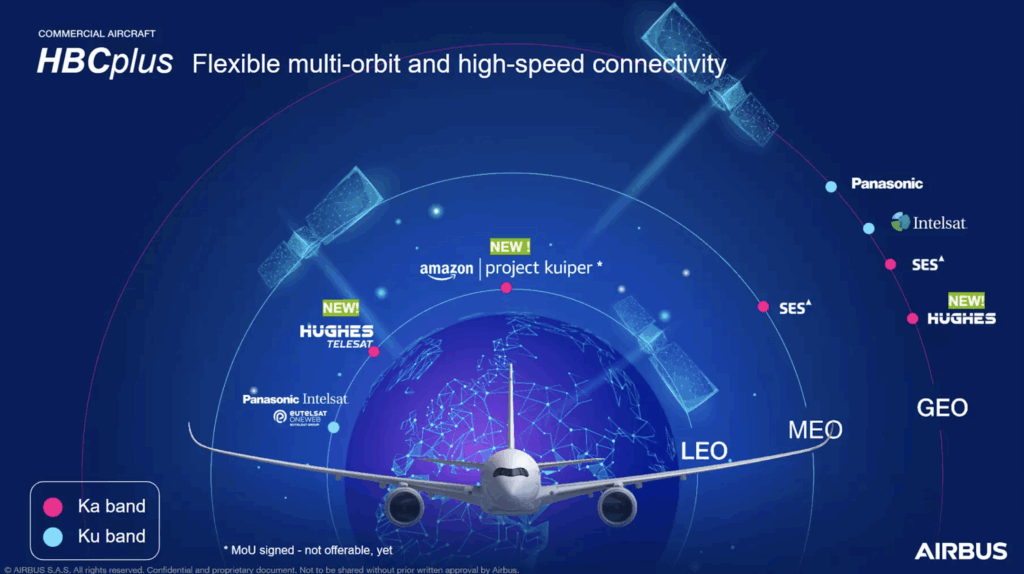
HBCplus is Airbus’ modular connectivity solution that delivers internet access and digital services to aircraft. While Airbus has traditionally partnered with geostationary satellite operators (GEO) such as SES and Intelsat, the company expanded into LEO earlier this year, including signing with Amazon’s Project Kuiper in April 2025.
The addition of Spacesail reinforces this shift, giving airlines multiple LEO options alongside existing GEO partnerships to improve coverage, performance, and resilience. The goal is to deliver reliable, global connectivity that aligns with rising passenger expectations for seamless internet access similar to what they experience on the ground.
The decision to integrate Spacesail reflects broader changes in the connectivity market, with LEO satellites becoming a central part of future digital aviation ecosystems. Airlines want more than basic internet; they want capacity that supports streaming, video calls, operational data transfer, and real-time digital applications that improve safety and efficiency. Adding another LEO option to HBCplus helps airlines address these needs.
Spacesail’s Global LEO Capability
Spacesail is building one of the world’s largest planned LEO broadband networks, often referred to as the Thousand Sails or Qianfan constellation. The company plans to deploy more than 15,000 satellites to deliver high-speed, secure, real-time connectivity across multiple industries.
Unlike GEO satellites that orbit roughly 22,236 miles (35,786 kilometers) above Earth, LEO satellites operate at altitudes of 1,200 miles (2,000 kilometers) or less. This proximity significantly reduces signal delay, which improves performance for streaming, interactive services, and real-time operational data. For airlines, lower latency can enhance the passenger experience and strengthen links between aircraft and ground systems.

Spacesail has already launched several batches of satellites and aims to have 648 in orbit by the end of 2025, expanding to 15,000 satellites by 2030. The project launched in 2023 and will roll out in phases, beginning with 648 satellites for regional coverage by 2025, followed by global coverage with an additional 648 satellites by 2027.
The company is positioning itself alongside other major LEO operators, including SpaceX’s Starlink and Amazon’s Project Kuiper, with a vision for a global broadband system that supports aviation, maritime, remote regions, and other markets where connectivity has been limited.