


AIX 2026: Defining the Future of the Connected Aircraft Cabin

Share
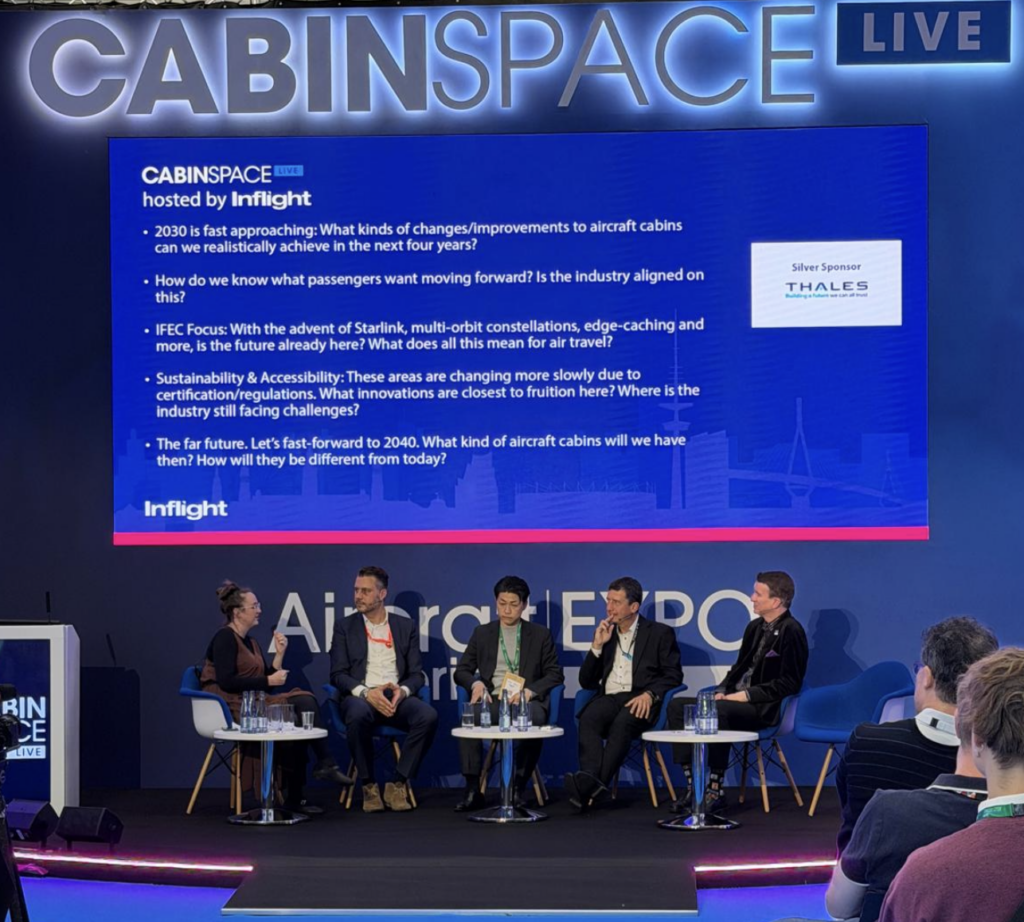
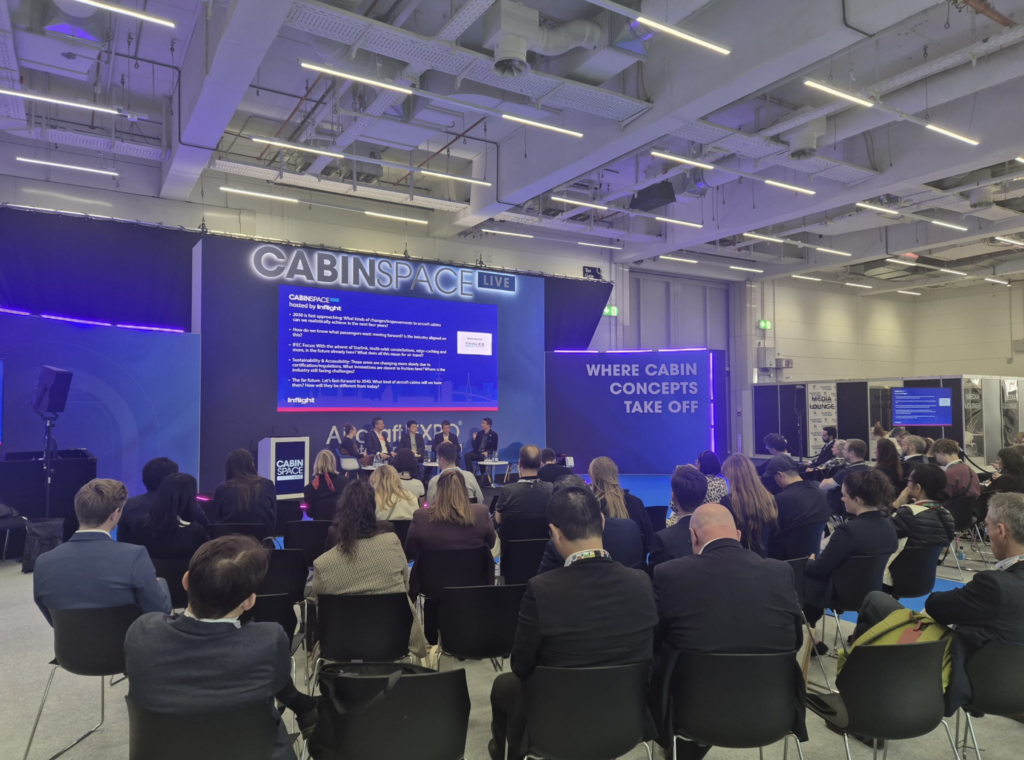
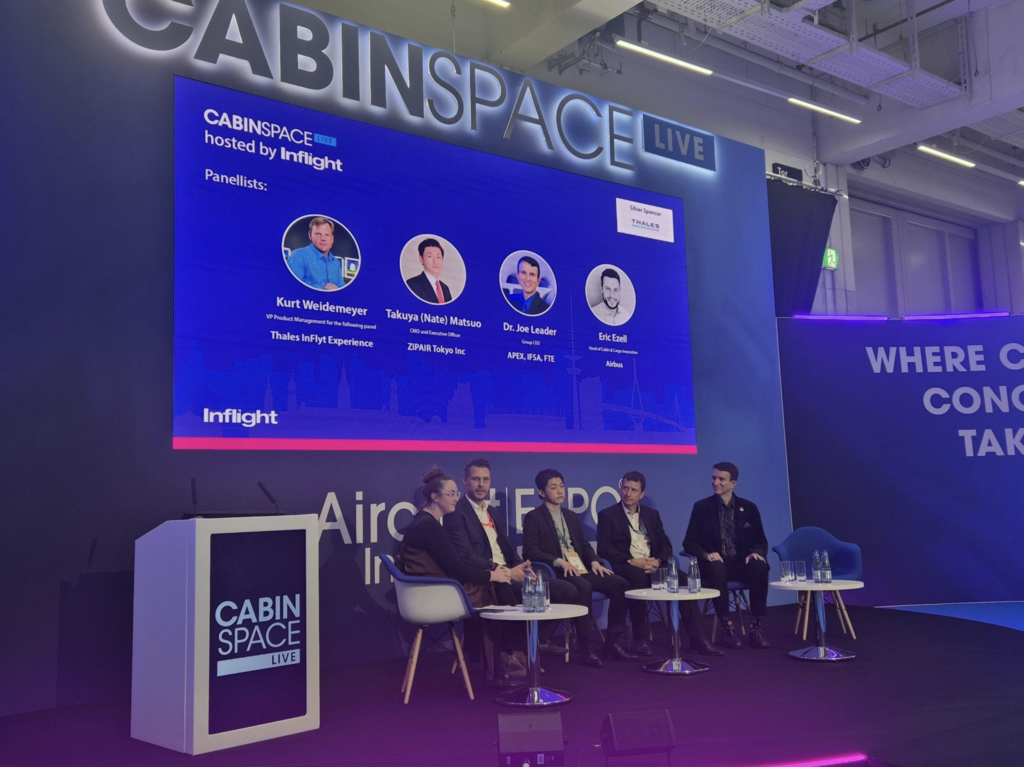
At Aircraft Interiors Expo (AIX) 2026, the future of the aircraft cabin took the spotlight during a CabinSpace Live panel moderated by APEX Insights Editor Stephanie Taylor, brought together four leaders with very different perspectives: ZIPAIR Tokyo CMO and Executive Officer Takuya Matsuo; APEX CEO Dr. Joe Leader; Airbus Head of Architecture, Technology and Innovation for Cabin and Cargo Eric Ezell; and Thales InFlyt Experience Chief Technology Officer Tudy Bedou.
Together, they explored how connectivity, digital cabin systems, and emerging technologies such as artificial intelligence are reshaping the passenger experience. The discussion highlighted both opportunities and challenges as airlines and suppliers work to deliver more personalized, accessible, and sustainable cabin environments by 2030 and beyond.
Connectivity and the Next Era of Cabin Experience
Taylor opened the discussion by noting that while aviation often moves more slowly than other industries, change in the cabin is already accelerating. She first turned to Dr. Leader, asking whether anything he had seen recently felt genuinely new in the cabin environment.
For Dr. Leader, the answer began with connectivity. “Watching the speed of connectivity get better than my home internet has been really impressive,” he said, recalling his first experience with United’s new Starlink product on a regional jet. “Downloading basically everything in the universe while it worked perfectly,” he said.
But Dr. Leader said the bigger surprise has been the continued rise of embedded screens. “It was long predicted that connectivity could mean the end of screens, and we’re actually seeing more and more installed at a faster basis,” he said. As display quality improves, sizes increase, and weight falls, he argued that the 2030s may bring seatback entertainment to airlines that once rejected it outright. “We could see airlines like Southwest Airlines, others that have never considered screens, suddenly coming online because of the engagement and the amount of revenue they can make.”
ZIPAIR Sees Connectivity as a Tool for Both Passengers and Crew
Taylor then shifted to Matsuo, whose airline is rolling out Starlink, and asked for the carrier perspective. Matsuo emphasized that connectivity should not be viewed only through the lens of passenger experience. For him, it also has major implications for employee satisfaction and airline operations.
Matsuo argued that airlines need to consider “not only customer experience and customer satisfaction, but also employee satisfaction and employee experience.” ZIPAIR expects to complete its Starlink deployment by the end of May, and Matsuo said the benefits already go beyond faster internet for passengers. Connectivity, he explained, gives flight attendants access to information they previously could not get and allows smoother communication between the ground and the aircraft.
Matsuo pointed to ZIPAIR’s development of in-house digital tools as another example of how the future cabin will rely on connected systems that serve both passengers and crew. Using passengers’ own devices, the airline has created a more streamlined inflight ordering process. Instead of pressing the call button, explaining the order, waiting, and then paying, passengers can order and pay right from their phones. The order is then sent straight to the crew with the seat number and item details included.
The result, Matsuo said, is a better experience for both sides of the transaction. “Passengers can just tap on their smartphone, and payment is completed in real time,” he said. “Crew members just bring the duty free item to their seat.” In his view, this kind of digital cabin workflow will become more important as labor shortages intensify. “We need to consider not only customer satisfaction, but also employee satisfaction.”
Thales Pushes a More Native Digital Cabin
From the supplier side, Bedou described how Thales is trying to build cabin technology around native connectivity rather than treat it as an add-on. Referencing the company’s new FlytEdge Aura platform announced earlier in the day, he said the goal is to create a faster-moving in-flight entertainment (IFE) environment, one that can evolve more like consumer technology.
Before Aura, Bedou said, Thales had already launched what he described as “the first natively connected IFE in the world.” That architecture matters because it changes how quickly ideas can move from concept to deployment. Older in-flight entertainment platforms, he said, were not designed around continuous connectivity and therefore moved through slower, more cumbersome upgrade cycles. FlytEdge, by contrast, “allows us to bring very quickly experiences to the IFE,” and to test and deploy those experiences far more rapidly.
Bedou said that pace is now critical because innovation cycles in seatback displays are shrinking. “I’ve been in IFE for 20 years, and I would say the life cycle of display used to be more like five, six, seven years. It’s accelerating.” To keep up, the industry has to embrace modularity, startup-style development, and platforms optimized for continuous improvement.
That same logic, he argued, will push the cabin toward a broader digital ecosystem. In his view, in-flight entertainment should become one node in a much larger, connected environment that links systems across the aircraft. “Be able to interconnect not only the in-flight entertainment, but with the galley, with the lavatories,” Bedou said, pointing to a more integrated cabin architecture. With better connectivity and onboard systems, airlines can predict issues earlier, personalize the experience, and make service run more smoothly across the cabin.
Airbus Envisions a More Intelligent, Responsive Cabin Environment
Ezell built on that vision from the OEM perspective, arguing that by the early 2030s the cabin itself will become more intelligent and more software-driven. With global connectivity expanding and data flowing more consistently between aircraft and ground systems, Airbus sees the opportunity to rethink how nearly every element of the cabin interacts with the passenger and the airline.
“Everything that you see one day will be smart,” Ezell said. In his view, future cabins will not rely as heavily on fixed hardware alone. Instead, they will increasingly use digital surfaces, lighting, and software-enabled interfaces that can be adapted much more quickly to seasonal needs, route needs, airline branding requirements, or even individual passenger use cases.
That could reshape the way airlines differentiate their cabins. Rather than depending only on permanent physical installations, they may be able to tailor the look, feel, and functionality of the cabin in more dynamic ways. Ezell described the cabin as becoming “a canvas,” adding that “light and image can blend with the physical environment to support wayfinding, advertising, accessibility, and information.”
He also tied that digital future directly to sustainability and service optimization. “The more the aircraft understands how products and services are used, the more precisely airlines can manage resources,” he said, pointing to improvements across everything from maintenance planning to catering loads.
AI Takes on a Bigger Role in the Cabin Experience
The discussion then turned to artificial intelligence. Bedou said AI is already beginning to move from concept to practical deployment. At Thales’ booth, he noted, the company is already demonstrating some machine learning and AI processing at the edge. Still, he characterized the current moment as “just the beginning of that revolution.”
Dr. Leader expanded the discussion by separating customer-facing AI from the deeper systems that passengers may never see. On the security side, he argued that AI will become increasingly necessary to defend against increasingly advanced cyber threats. “The only way to fight it properly is not to have set security parameters, but to actually have an AI agent that’s part of the aircraft, on the aircraft, in its security system,” he said.
For passengers, however, AI may be felt most clearly through smoother communication and more relevant information. Dr. Leader envisioned a future where onboard announcements are automatically made clearer, easier to understand, and translated into different languages depending on the traveler. He also described screens and mobile devices showing real-time information tailored to the passenger’s needs, whether that means clearer turbulence explanations, live visualizations of weather conditions, or proactive help with missed connections and delays. “That type of information will show up on your screen and on your mobile device simultaneously,” he said.
Accessibility Takes a Bigger Role in Cabin Design
The conversation then shifted to accessibility, one of the most important and fast-evolving areas in cabin design. Taylor highlighted its growing importance, with each panelist offering a different perspective.
Matsuo said advances in translation technology could reshape how airlines recruit and operate. As real-time translation improves, language barriers may become far less important. “If we use real-time translation, we can recruit staff from all over the world, not require language,” he said, adding that by 2040 airlines could hire globally without limiting candidates based on language.
Ezell said accessibility has been a core focus for Airbus for years, shaped by working closely with passenger groups and recognizing that reduced mobility goes far beyond just wheelchair users. “Roughly 1.3 billion people worldwide have some form of reduced mobility,” he said, pointing to needs related to hearing, vision, and movement.
Airbus is looking at issues ranging from accessible lavatories and support for personal wheelchairs to digital tools that improve autonomy for blind or low-vision passengers. With more connected cabins, he said, airlines may be able to provide automatic guidance to passengers’ personal devices, answering practical questions such as where a seat is located or whether a lavatory is occupied. “This is clearly a field where collaboration is key,” Ezell said. He added that connectivity will play a central role in enabling that shift, noting it can help “provide information automatically to personal devices of passengers,” improving independence and ease of navigation throughout the cabin.
Bedou described Thales’ own accessibility work, including a visually impaired user interface developed specifically for blind passengers and now flying on two major international airlines, with a third coming soon. He also highlighted sign-language avatar work, personalized audio experiences, and demonstrations that transcribe and translate live cabin announcements in real time. “What was a dream back then,” he said, “now there is technology to be able to do that in real time.”
Dr. Leader acknowledged the progress, but said the industry still has more work to do.“Our airlines need to step up their game and go beyond what is required by the regulations,” he said, especially as global populations age. He also pointed to new possibilities such as AI-generated audio description for content libraries and more inclusive ways of reaching deaf passengers during alarms or safety events.
Sustainability Expands Beyond Weight
The conversation closed with sustainability, where each speaker emphasized a different layer of the challenge. Matsuo focused on operational efficiency. Because ZIPAIR already relies on digital pre-ordering, the airline can reduce food waste and avoid carrying unnecessary products. He gave one example of a route from Tokyo Narita where 150 cans of beer might be loaded even though only two or three are usually sold. “Our system can allow us to optimize food waste and show how many products are necessary for each flight,” he said. Better data, he added, allows the airline to adjust loading more precisely, reducing both waste and fuel burn at the same time.
Ezell said sustainability in the cabin is not driven by one factor, but by many working together. It includes space use, lightweight design, new materials, circularity, and stronger cross-industry collaboration. “There’s literally nothing you cannot work on,” he said, pointing to a wide range of opportunities across the cabin.
Bedou brought the issue back to in-flight entertainment design. “First and foremost, it’s about weight,” he said. For Thales, that means lighter systems, more modular products, better repairability, and increased use of recycled materials.
Dr. Leader closed with a broader industry reminder. “Ninety-eight percent of our carbon emission comes from the weight of the aircraft, and it’s from the fuel that we burn,” he said. Incremental improvements matter, but real progress will require more fundamental changes.
Taken together, the panel’s message was clear: the cabin of 2030 will be more connected, more intelligent, and more adaptive, but it will also be judged by how well it solves real human needs. Whether it is personalization, accessibility, sustainability, or smarter digital services, the airlines that stand out will be the ones that use technology to genuinely improve the travel experience and make it more seamless, inclusive, and useful.