


AIX 2026: Defining the Future of Long-Haul Cabin Comfort
Share
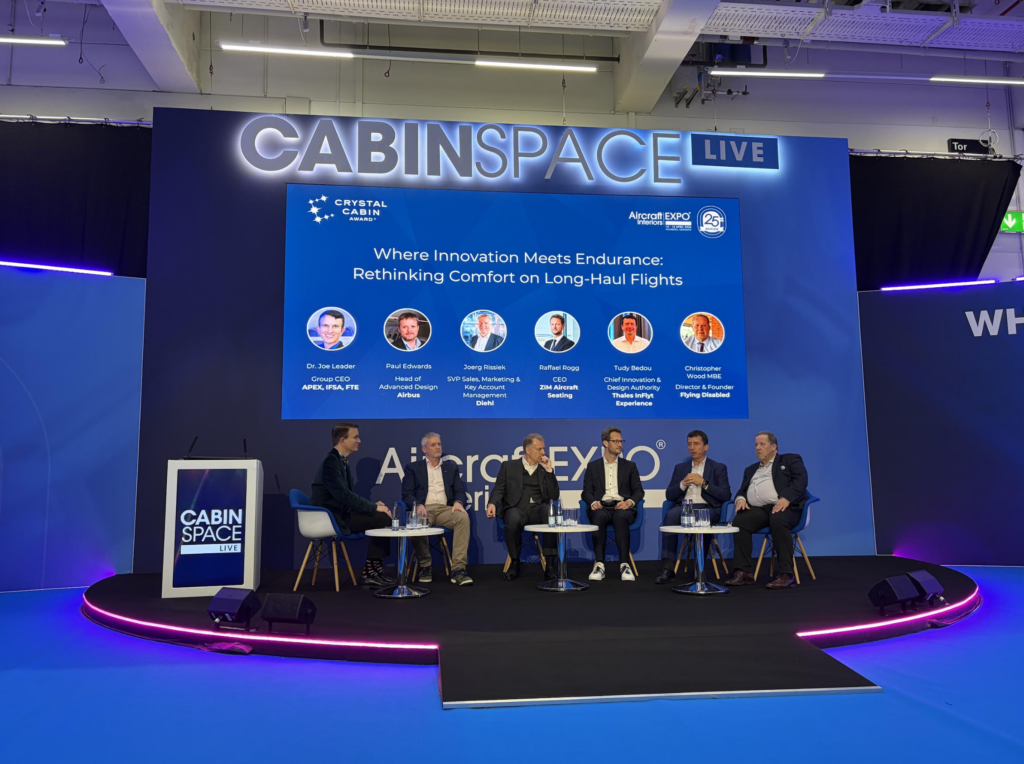
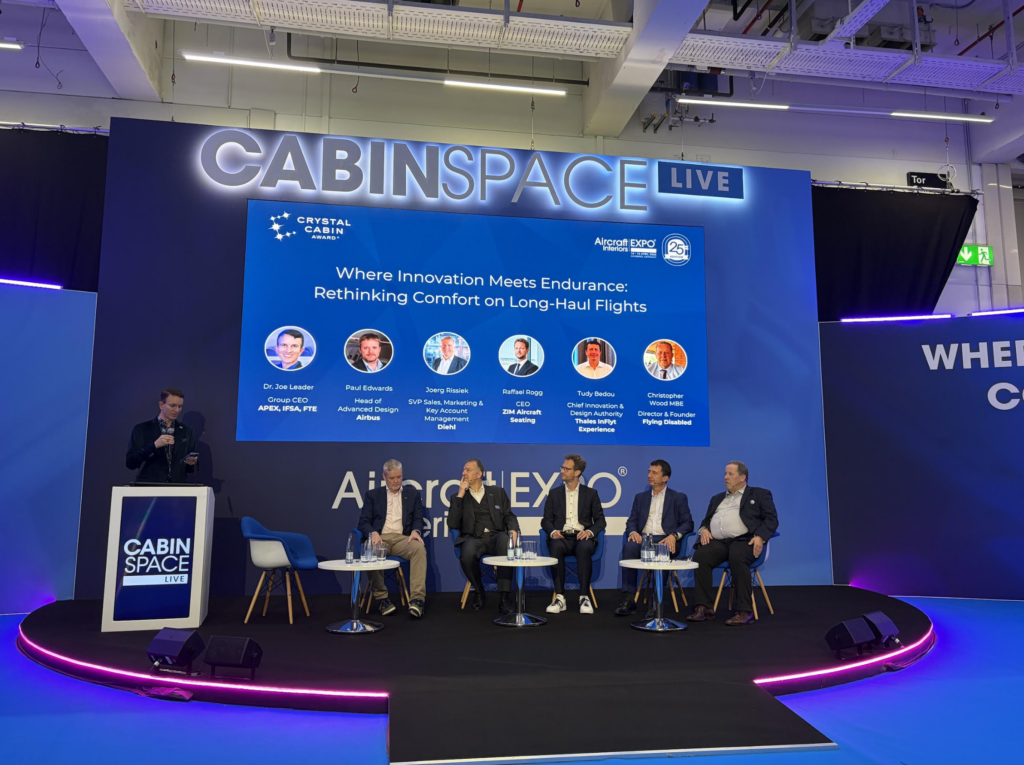
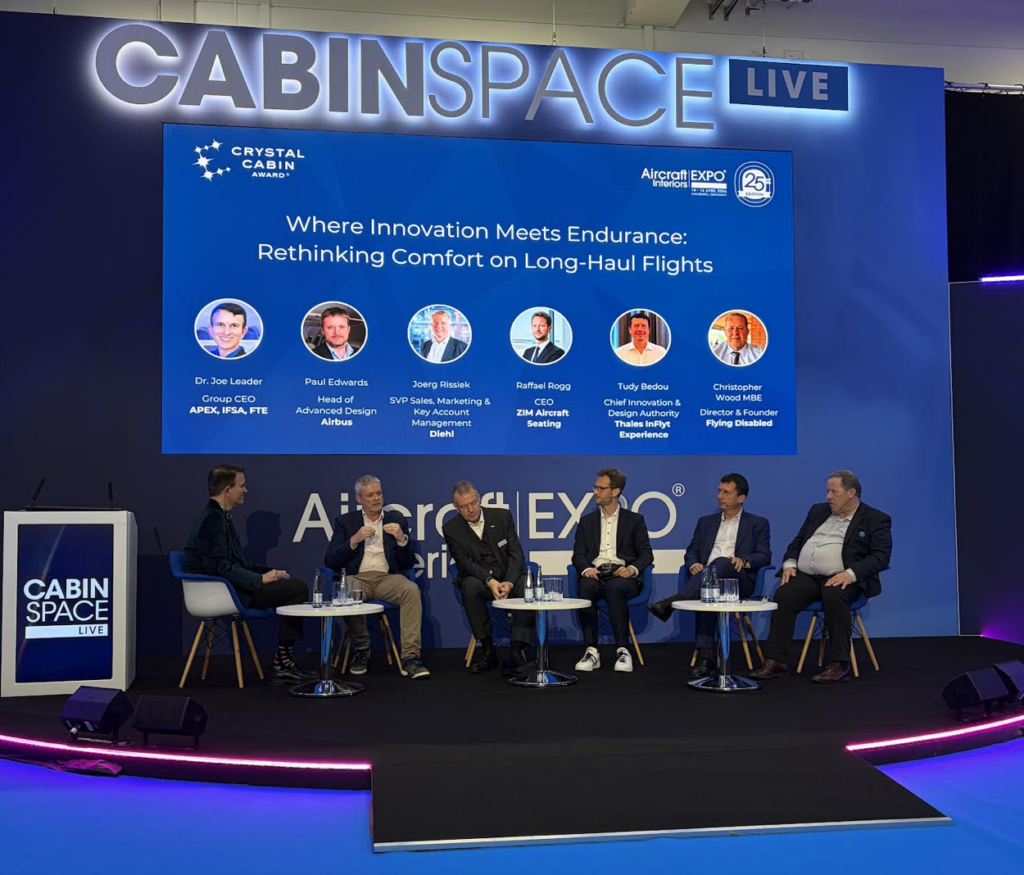
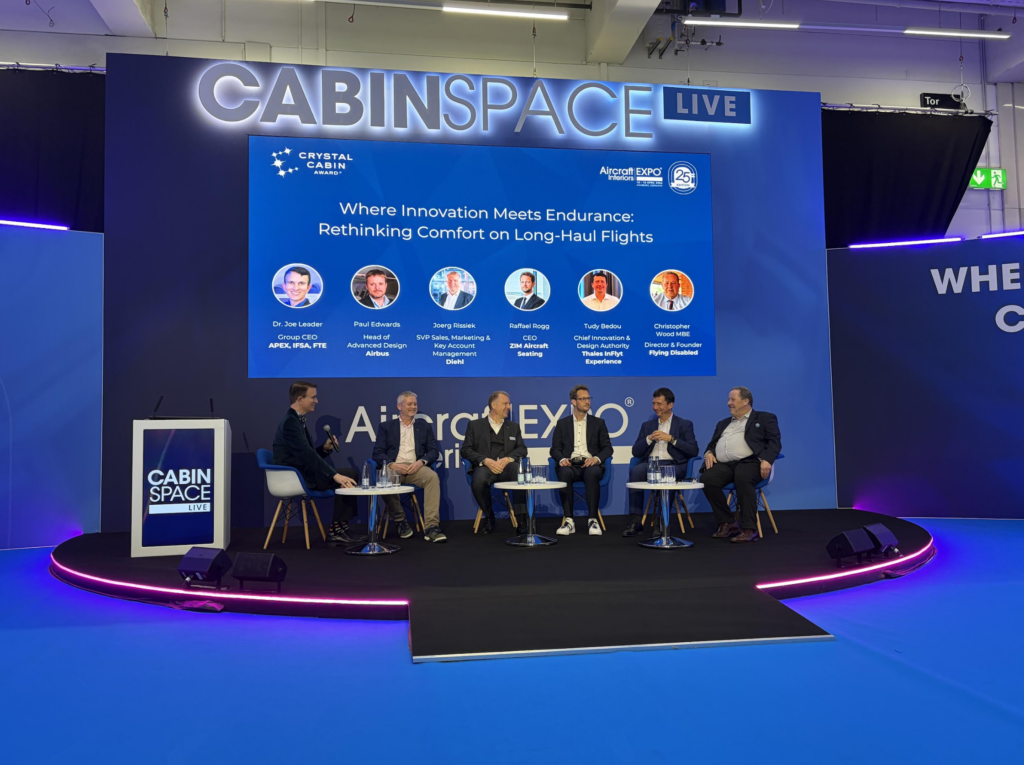
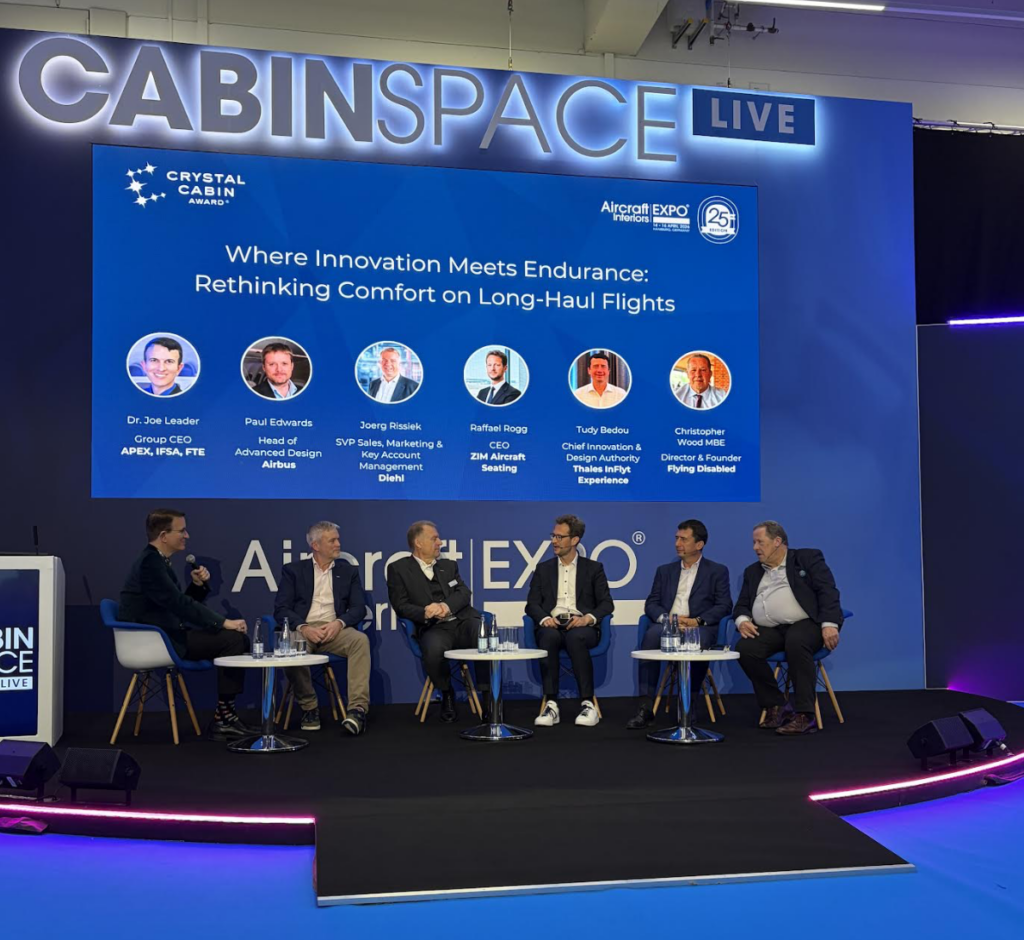
At Aircraft Interiors Expo (AIX) 2026, long-haul passenger comfort took center stage during a CabinSpace Live panel moderated by APEX CEO Dr. Joe Leader, which brought together five leaders with very different perspectives: Airbus Head of Advanced Design Paul Edwards; Diehl Aviation Senior Vice President Sales, Marketing and Key Account Management Joerg Rissiek; ZIM Aircraft Seating Group CEO Raffael Rogg; Thales InFlyt Experience Chief Technology Officer Tudy Bedou; and Flying Disabled Director and Founder Christopher Wood.
The conversation reflected many of the broader themes shaping this year’s Crystal Cabin Awards, where accessibility, modularity, sustainability, and premium cabin innovation remained major focus areas across the exhibition floor. Together, they explored how airlines and suppliers are rethinking long-haul comfort through design, accessibility, modularity, and sustainability. The discussion highlighted both opportunities and challenges as the industry works to create cabin environments that are more inclusive, more efficient, and better suited to the physical and emotional demands of long-haul travel.
Comfort Must Go Beyond the Seat
Dr. Leader opened the discussion by noting that ultra-long-haul flying is changing the meaning of endurance in the cabin. As routes such as Sydney to London and Sydney to New York become reality, airlines must think beyond traditional definitions of comfort.
Edwards said comfort today is far more complex than simply giving passengers extra space or softer materials. “Comfort is much more than just physical,” he said. “It’s more than having a bit of space and something soft.”
For Airbus, that means blending physical comfort with service and design into one coordinated experience. He pointed to the company’s A330neo Airspace cabin enhancements, including electrochromic windows, new ceiling features, and updated sidewalls, as examples of how airlines can shape mood and perception throughout the journey.
But Edwards argued that individual features alone are not enough. “One product alone is just not enough,” he said. Instead, airlines should think about how to “curate a really great travel experience” and then use physical comfort, service, and design to support it.
Accessible Space Must Also Work Commercially
Dr. Leader then turned to Rissiek, whose Diehl Aviation team won the 2026 Crystal Cabin award in the accessibility category for an adaptable lavatory concept that combines accessibility with commercial efficiency.
Rissiek explained that the concept combines three lavatories in a center block and allows two toilet rooms to be opened into one larger accessible space when needed. “That’s where you need more space,” he said, noting that the design can better support a wheelchair user, a supporting companion, or even someone traveling with a broken leg.
The concept also helps airlines preserve valuable cabin real estate. Depending on the layout, operators may gain additional seats or improve seat pitch while still enhancing accessibility. “The cool thing about it is, in addition, you might win some seats or seat pitch,” he said. It can also be introduced on both new aircraft and retrofit programs, giving airlines more flexibility.
For Rissiek, the larger lesson is that accessibility should not be treated as separate from commercial planning. It should be integrated into smarter cabin architecture from the start, with solutions tailored to different aircraft sizes and mission profiles.
ZIM Uses Wood to Rethink Seat Weight and Space
One of the panel’s most striking discussions centered on ZIM Aircraft Seating’s new approach to seat structure. Dr. Leader described his own reaction as a Crystal Cabin Awards judge when he encountered a fixed-shell seat made with wood while still delivering major weight savings. “If you told me that my seat was going to be made out of wood and that I would love it, I would not believe you until I saw it,” he said.
Rogg explained that the goal was to significantly reduce the weight of fixed-shell seating while maintaining structural performance and certification standards.
“We really had a target to reduce the weight fixed shell seat significantly,” Rogg said. That search led the company back to wood, which played a major role in early aviation because of its strong strength-to-weight ratio. “We came across wood again as a low weight and high strength material,” he said.
The material also creates more usable passenger space because of how the structure can be optimized. Rogg added that durability and repairability were built into the concept from the start. “We built up the seat completely modular,” he said.
That modularity allows faster maintenance, easier replacement of damaged parts, and longer product life, supporting both sustainability and airline economics.
Thales Pushes a More Modular and Inclusive Digital Cabin
From the technology side, Bedou described how Thales is working to make the connected cabin more adaptive, more personalized, and more inclusive, while also redesigning in-flight entertainment (IFE) around lighter, modular systems.
He said FlytEdge has already been flying for more than two years, proving the value of connected onboard servers and faster software updates. The next step, FlytEdge Aura, extends that modular approach to the seatback itself. Instead of replacing entire units, the system separates the display, electronics, and frame into parts that can be upgraded independently. “You don’t want to throw away that monitor,” he said. “Maybe you can change the electronics.”
Weight remains a key focus, with Thales rethinking cables, connectors, and system architecture to reduce unnecessary mass while maintaining performance.
At the same time, Bedou highlighted the company’s accessible user interface (UI) for blind passengers, already flying with two airlines and expanding to a third. “The goal was really to run a user interface that would address the needs of blind passengers,” he said, noting the system was developed with organizations such as the American Foundation for the Blind and built around familiar gesture controls already used on smartphones.
Airline interest has grown quickly. “All the airlines that are coming to see us are now asking us, how about accessible UI?” Bedou said. He added that the next step is expanding access for passengers who cannot easily use touchscreens, opening the door to voice, gesture, and personal device control as the next phase of cabin innovation.
Accessibility Moves Closer to the Center of Cabin Design
The discussion then shifted toward accessibility, where Wood argued the industry is finally beginning to engage more seriously after years of slow progress. Many of the accessibility-focused concepts showcased during this year’s Crystal Cabin Awards reflected that same shift, with greater emphasis on independent travel, intuitive interfaces, and human-centered cabin design.
“This industry is actually now starting to engage,” he said, adding that when he first entered the space a decade ago, only a few stakeholders were treating accessibility as a strategic design issue. In his view, momentum has improved, but the work remains unfinished.
Wood praised several innovations on display at AIX, especially systems that allow blind passengers to independently control their seat environment, lighting, or entertainment options without relying on cabin crew.
He also stressed that many accessibility solutions end up benefiting all passengers, not just travelers with disabilities. “That is something for everyone,” Wood said, pointing to translation tools, text-based communication, and visual guidance systems that can improve the experience across the cabin.
Wood urged the industry to think beyond compliance and focus more on empathy and human-centered design. “We need to be not AIX essential, empathy essential, human centric,” he said, arguing that real innovation starts with understanding how people actually travel.
He also highlighted the growing importance of aging demographics. As more older travelers continue flying, airlines will need cabins that offer easier movement, clearer interfaces, and stronger physical support.
Dr. Leader agreed and praised Delta Air Lines’ decision to make every suite in its new Delta One cabin wheelchair accessible. He said airlines need to move beyond minimum requirements and think more broadly about dignity, independence, and inclusion.
First Class Becomes a Test Case for the Cabin as a System
The conversation then turned to premium cabins, an area that continues to dominate both airline investment and Crystal Cabin Awards attention as carriers compete to create more differentiated long-haul experiences. Seating, branding, operations, and passenger comfort increasingly need to work together rather than as separate decisions.
Edwards used Airbus’s new A350 first class solution, revealed at AIX with launch partner collaboration, as a clear example of that shift. He noted that the A350 has already become a flagship aircraft for premium products, with around ten airline customers using it to showcase first class experiences.
“We’re very proud of our A350,” Edwards said, noting that the aircraft continues to evolve as customer expectations rise. For Airbus, that means first class can no longer be designed as a standalone seat or suite. It has to fit within the broader economics and functionality of the aircraft.
When developing the new concept, Airbus worked directly with airline customers and used rapid architecture lab mockups to refine ideas in real time. “We co-created this concept with them,” he said.
That process, he explained, helped Airbus improve the use of revenue-generating space while also giving airlines new opportunities for branding, lighting, and premium differentiation. At the same time, the design still had to meet practical needs for cabin crews and operational teams.
“It’s about getting the balance absolutely right,” Edwards said. “We were able to improve the revenue space for our airlines” while also enhancing the customer experience.
For Edwards, that balance defines the next generation of premium cabins. The strongest first class products will not simply look luxurious. They will integrate comfort, operational logic, airline identity, and commercial performance into one coordinated environment.
Sustainability Moves Beyond Weight Alone
The conversation closed with sustainability, where each speaker emphasized a different layer of the challenge.
Edwards said sustainability and transparency will increasingly shape cabin decisions, but airlines need better information to make smart choices. “Demand the data,” he said, urging carriers to push suppliers for measurable environmental and lifecycle performance.
He also argued that the industry should stop viewing circularity as a burden. Instead, airlines and suppliers should see it as a source of new business models, smarter sourcing, and more efficient end-of-life planning.
Rissiek added that sustainability can no longer be judged only by lighter products. Materials must also be durable, maintainable, recyclable, and attractive to passengers. “It is a challenge,” he said, referring to the need to combine all of those goals at once.
Rogg made a similar point from the seating perspective. Sustainable materials and recyclability matter, but real-world trade-offs appear quickly once comfort, space, maintenance, and airline economics are added to the equation.
“It turns to a trade-off at some point,” Rogg said. “How much space are you going to give them?” he added, referring to the constant balancing act between sustainability goals and passenger expectations.
Bedou brought the discussion back to cabin electronics, where he said material choices can be more complex than they appear. “Plastic in our domain is pretty tricky,” he said, explaining that many plastics struggle to meet aviation flammability standards. Even so, he pointed to newer certified recycled materials that could help improve circularity in future cabin systems.
Dr. Leader closed with a blunt reminder about aviation’s emissions profile. “Ninety-eight percent of our carbon emission comes from the weight of the aircraft, and it’s from the fuel that we burn,” he said. That means progress in sustainability will need to come from several directions at once: lighter cabins, smarter materials, better modularity, stronger circularity, and more efficient operations.
Looking Ahead
As the panel closed, Dr. Leader asked each speaker for a brief vision of where the cabin is heading. Edwards pointed to major upcoming leaps in ultra-long-range travel and suggested that some major product developments are still to come. Rissiek said the industry should focus on improving comfort in all classes, not just the premium cabin. Rogg stressed that the future of seating lies in better modularity, exchangeability, and design. Bedou summed up his view in four words: “smart, interconnected, secure and exciting.” Wood ended with a direct appeal not to forget economy passengers and accessibility in the pursuit of premium innovation.
Taken together, the panel’s message closely mirrored the broader direction seen throughout AIX and the Crystal Cabin Awards this year: long-haul comfort is no longer just about a better seat or a bigger screen. It is about how every system in the cabin works together to reduce stress, improve dignity, and make extended travel more manageable. The airlines and suppliers that lead the next decade will be the ones that design cabins around real human needs, not just hardware alone.