


JSX Bets Big on Smaller Airports, Aircraft to Give Passengers Their Time Back

Share

JSX’s ATR turboprop has achieved a Net Promoter Score (NPS) of 92, CEO Alex Wilcox said at FTE Global / IFSA Global Expo. In its second month of operation, the aircraft had already exceeded the airline’s jet score.
JSX has built its model around making flying simpler, faster, and more comfortable. Much of JSX’s appeal comes from simplifying the entire journey, from allowing passengers to arrive 20 minutes before domestic departures to avoiding the crowds and long walks that often come with larger airports.
ATR Opens the Door to New Markets
The ATR 42-600, configured with 30 seats, is already helping JSX put that strategy into practice. The turboprop gives the airline more flexibility at smaller airports and opens the door to markets that may not work as well with its Embraer regional jets. JSX and ATR signed a letter of intent for up to 25 aircraft in 2025.
Santa Monica is one of the clearest examples, with ATR service to Las Vegas launched in December 2025. Travelers living on the Westside of Los Angeles can spend a significant amount of time reaching Los Angeles International Airport before a trip even begins. Flying from Santa Monica brings the airport closer to those passengers and helps save time before departure.
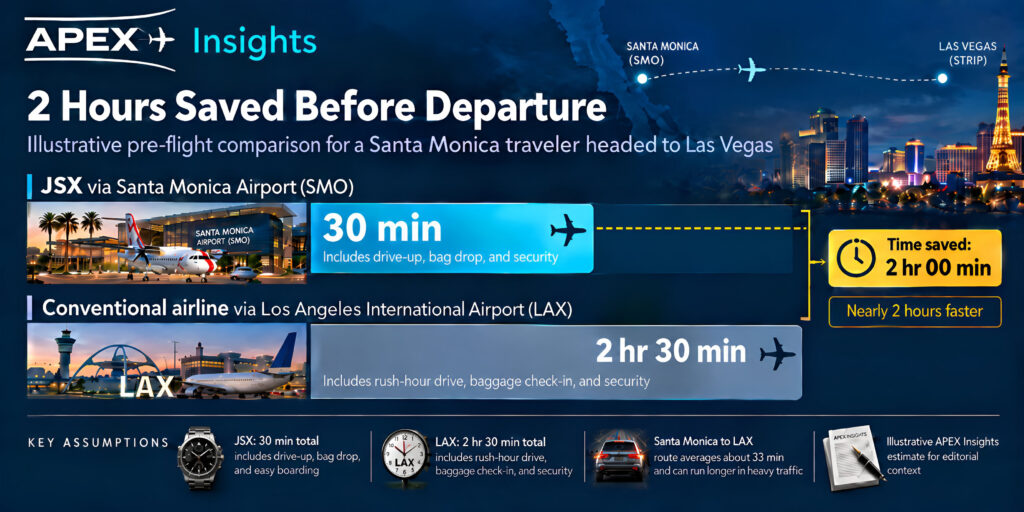
An illustrative APEX Insights comparison suggests that a traveler heading from Santa Monica to Las Vegas could save nearly two hours before departure by flying JSX from Santa Monica Airport rather than a conventional airline from Los Angeles International Airport. The estimate allows 30 minutes total for the JSX experience, including drive-up access, instant bag drop, and easy boarding, compared with two hours and 30 minutes for a conventional airline journey, including the rush-hour drive to LAX, baggage check-in, and security. With the Santa Monica-to-LAX route averaging about 33 minutes and often running longer in heavy traffic, the comparison helps show how much of JSX’s advantage comes from simplifying the airport experience before passengers ever leave the ground.
Wilcox said the response reflects how travelers care more about having the right aircraft for the route than whether it is a jet or turboprop. “People want the right tool for the job,” he said. “If you’re going to St. Barts, you’re on a turboprop, or maybe a piston airplane.”
That is how JSX sees the ATR. “It enables us to reach markets that otherwise we would not be able to reach,” Wilcox said. “Santa Monica is the most obvious example right now.”
The aircraft also gives JSX more options at airports where runway length, elevation, temperature, or other operating conditions can make jet service more difficult. “There are other high and hot airports that the ATR can fly to where jets can’t,” Wilcox said. “It’s really a matter of having the right tools for the job, and the ATR opens up a huge number of new capabilities for JSX that we can’t address otherwise.”
That flexibility could help JSX reach more communities where passengers currently have to drive farther to a major airport, connect through another city, or deal with limited nonstop service. Reaching those markets still depends on aircraft supply and airport real estate. Wilcox cited the end of Embraer 145 production and competition for space at key airports.
Convenience Over a More Elaborate Cabin
That thinking also shapes JSX’s cautious approach to transcontinental flying. Premium travel between New York and Los Angeles ranks among the most competitive markets in the United States, with airlines investing heavily in lie-flat seats, lounges, upgraded food, and other premium products. Wilcox said JSX could theoretically enter those markets one day, but he does not currently view them as the company’s strongest opportunity.
“I would never say never,” he said. “But the Transcon market, especially the big cities, are pretty well served.”

Economics also play an important role. JSX operates aircraft with around 30 seats, giving travelers considerably more space than they would typically find on a regional aircraft. Adding lie-flat seats would reduce capacity even further while longer flights would bring additional operating costs. “I don’t see the economics of a 30-passenger lie-flat product ever really working very well,” Wilcox said.
Instead, JSX is targeting routes where it can make travel easier. That could mean flying from an airport closer to home, saving passengers time before departure, or adding nonstop service where convenient options remain limited. Rather than competing on the most elaborate premium cabin, the airline is putting more emphasis on convenience.
Keeping the Onboard Experience Simple
That philosophy also guides JSX’s food and beverage service. The airline offers complimentary snacks and drinks onboard but skips the type of full meal service passengers may find in a traditional domestic first-class cabin. Wilcox does not see much reason to change the food offering right now. “It’s tough to do airline catering well,” he said. “Our longest flights are three hours, so we don’t really perceive the need for any more than the snacks we’re serving today.”
With most JSX flights relatively short, a more complicated meal service could add cost and make the operation more difficult without adding enough value for passengers. Wilcox also noted that just because an airline serves a meal does not always mean travelers would prefer it over something they bring onboard themselves. “That could change if the stage length changes, but I don’t really think that’s in our future,” he said.
JSX takes a similar approach with its seats. The airline’s light-colored leather seats have become a recognizable part of the cabin, and its different aircraft configurations avoid the traditional middle seat. Wilcox said the airline continues to look at ways to improve the cabin, but comfort matters more than changing the seats simply for appearance.
“We’re always looking to make the cabin more comfortable,” he said. “I’m more worried about the comfort of the seat than I am the color.”
JSX’s early start gave the airline time to make Starlink a normal part of the travel experience rather than simply another onboard feature. Passengers can stream, work, browse the internet, and participate in video calls while flying.
That flexibility helps travelers who want to remain productive, but it can also cause problems when one passenger’s internet use starts affecting everyone around them.
“We just ask people to mind their manners because they’re clearly bothering somebody else,” Wilcox said.
JSX also trains its crew members to step in when necessary. Wilcox said employees learn to handle those conversations in a way that avoids confrontation while still addressing the problem.
The Next Aircraft, the Same Priority
JSX is already thinking about what comes next. “I think the future is going to be the next hardware platform,” Wilcox said.
Wilcox pointed to future aircraft that could take off and land using dramatically less space than today’s airplanes, potentially allowing travelers to depart from locations much closer to where they live or work. “If you can get an airplane that can take off in 300 feet and then 60 or 70 feet, and you can go connect rooftop to rooftop as opposed to having to go to an airport to go somewhere, I think that’s going to be great for our customers in the future,” he said. Onstage, Wilcox also described flying Electra’s prototype and identified certification as the main hurdle before deployment.
For now, JSX continues to focus on the parts of the journey it can improve today. “We are constantly looking for the pain points,” Wilcox said onstage. He described work on boarding, baggage delivery, and check-in.

Wilcox also urged airlines to give crew members the tools to resolve customer problems without sending passengers elsewhere for help.
For other airlines, JSX’s approach suggests a practical test: measure the time passengers spend on airport access, check-in, boarding, and baggage collection, then prioritize the delays they can reduce.
For JSX, the next phase starts with the time passengers get back. “Our job as an air carrier is to simplify as much as possible for our customer,” Wilcox said.
“We want every passenger to enjoy the speed and ease of JSX at airports nationwide,” APEX Future Travel Experience Group CEO Dr. Joe Leader shared. “Walk-through screening at TSA checkpoints and reliable security-time estimates on passengers’ phones could help bring that vision within reach. Our goal goes beyond shorter lines: greater certainty about total travel time, less stress, and more time for the people and experiences that make travel worthwhile.”