


APEX FTE EMEA 2026: Successful Ancillary Revenue Generation Relies on a Customer-Centric Approach

Share
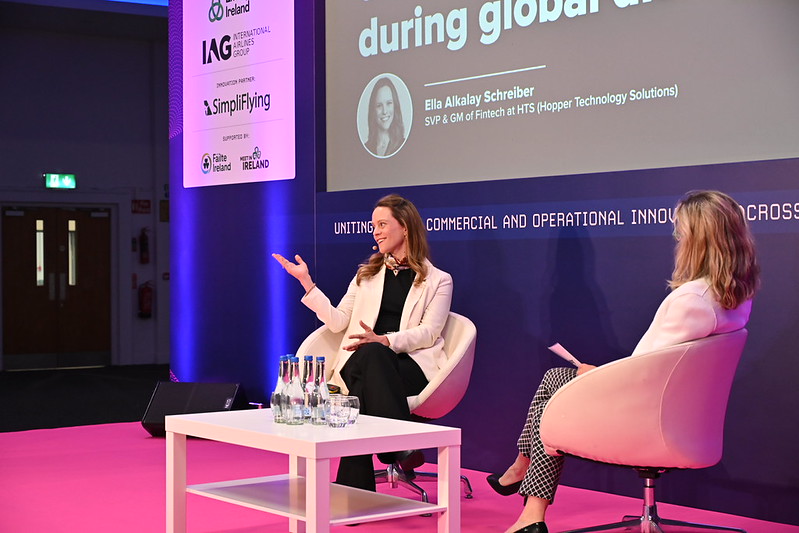
During this year’s APEX FTE Ancillary & Retailing conference session titled “Case study spotlight: Airline retailing and ancillary revenue excellence powered by new technology, approaches and collaborations,” delegates heard presentations from Finnair’s newly appointed Head of Products & Retailing Salla Rinta-Canto; TravelX Director of Business Development Martin Restrepo and Volaris Revenue Management Director Eduardo Morales; and Hopper Technology Solutions’ SVP & General Manager FinTech Ella Alkalay Schreiber. Each shared the opinion that revenue growth is tied to removing friction and increasing flexibility for passengers.
Finnair: Customer Choice is at the Core of Airline Retailing
During her presentation, Finnair Head of Products & Retailing Salla Rinta-Canto detailed two initiatives recently undertaken by the airline to help meet its ambitious reselling and ancillary revenue targets.
The first was a personalized discount experiment based on inflight meals, “because we identified there was a lot of potential to do more with those in the booking flow,” she explained. Finnair focused on two specific customer segments: “Churn-risk customers” who had bought pre-order meals in the past but hadn’t done so again; and new customers that had never bought pre-order meals before. The carrier applied a 20 per cent discount using a simple message pop-up, with Rinta-Carlo noting there was “no big UX effort required.”
The results included included improvements in both conversion rate and revenue per passenger across both types of customer. “The key takeaways from this were that we can target discounts to really make sure that we are also creating incremental sales and that personalization should be based on willingness to pay,” she shared.
“We can target discounts to really make sure that we are creating incremental sales.”
– Salla Rinta-Canto, Finnair
The second example Rinta-Carlo talked about in terms of improving ancillary sales is the order-to-seat capability Finnair has introduced on Airbus aircraft operating its European flights. Accessed via an online portal on passengers’ personal electronic devices, it means that they can not only find out about products in more detail, but “they can also get a discount if they order several products at the same time as well as see additional product recommendations.
“Having these mobile payment methods is a really important part of it, because if you have to use your credit card, what if it’s in your wallet in the overhead bin?” she went on. “It means that you have access to the service all the time, and it’s also a good foundation for further personalization that we can apply later on. The operational efficiency is clear, it’s a much smoother process, and all of this leads to incremental ancillary revenue.”
Rinta-Carlo rounded off her presentation by confirming Finnair has already witnessed higher conversion rates and larger basket sizes.
Her key takeaway for delegates was that personalization is expanding to cover the whole passenger journey, not just the booking flow; and the industry is at the beginning of the personalization journey, where there’s still lots more to implement and to achieve.
Volaris & TravelX: Post-Booking Revenue Optimization is a Win-Win
TravelX Director of Business Development Martin Restrepo began the second case study of the session by framing post-booking revenue optimization as a newer frontier in terms of generating ancillary revenues. “A lot of innovation has gone into the revenue management space over the last decade; so into things like advanced forecasting and dynamic pricing,” he said. “The focus has been up to and including the initial booking of the seat, but as we all know, a lot of things can happen after that initial booking. As a passenger, plans can change. As an airline, demand patterns can change, competitors can take certain actions, and up until now the industry has really lacked the tech tools to address and continue the revenue optimization after that initial sale of the seat.”
The company’s post-booking revenue optimization engine, RMX, is being used by Volaris to continuously identify opportunities in its network to generate incremental revenue. Restrepo explained, “So, flights that are filling up faster than expected, where if we were to open up seats on those flights, we could resell those at higher prices.”
“We are generating up to 1.9 per cent of the revenues of the company.”
– Eduardo Morales, Volaris
The engine dynamically targets passengers on those flights with personalized offers to change their plans or not to travel. “We can offer different types of offer constructs here, like buybacks or flight swaps; [Volaris] offer different types of currency as compensation.” If passengers accept the offer, the engine can reallocate them and resell their tickets at a higher price.
“There’s obviously the financial benefit, the revenue uplift that the airline gets, but at the same time you’re able to optimize your passenger experience, and those two are sometimes in conflict in this industry,” Restrepo posited. “On the passenger experience side, you’re rewarding them and giving them more flexibility, and on top of that, you also reduce the risk of a potential denied boarding.”
Volaris Revenue Management Director Eduardo Morales revealed that since implementing TravelX’s solution, its conversion rate has doubled from two to four per cent. During the previous quarter, Morales said its offers had reached 1.5 million passengers, which means it saw approximately 60,000 passengers take up their offer.
“Not only is the conversion important, but also we try to generate revenue by selling those seats again. The models that we developed with TravelX are generating above 90 per cent of resold seats, and that’s obviously generating a higher revenue […] Now we are generating up to 1.9 per cent of the revenues of the company,” Morales revealed.
Hopper Technology Solutions: Generating Loyalty from Disruption
Hopper Technology Solutions (HTS) SVP & General Manager FinTech Ella Alkalay Schreiber highlighted the company’s “two most popular and profitable products” are ‘Cancel for Any Reason’ and ‘Disruption Assistance,’ which are sold to passengers as ancillaries directly through an airlines’ booking channels. She shared that HTS sees “a double-digit attach rate” on both, adding, “We’re able to increase revenue for the airlines, but more importantly customer satisfaction – customers love the product – and also reduce the [airlines’] operational burden, so three very key matrices in our industry today.”
Schreiber detailed, “Cancel for any reason makes your trip fully refundable: three taps and you can cancel. You can do it up to 24 hours prior to departure, which is when disruption assistance kicks in. So 24 hours before departure, we proactively monitor the flights of those with disruption assistance. If we see a flight is delayed by more than two hours or being canceled, we would proactively reach out to them with two options: they can either rebook on any flight available the same day on any airline, including to alternative destinations. For those who want to keep their original flight, they get a 100 per cent refund of their original ticket, so essentially they fly for free.”
“When the resolution is slick for the traveler in their time of need is when the customer satisfaction goes up.”
– Ella Alkalay Schreiber, Hopper Technology Solutions
The popularity of the product makes sense when framed within the context that disruptive days, which Schreiber defines as “days with more than 10 per cent of [an airline’s] departures being disrupted,” have doubled since 2019. She commented, “When we survey customers about what is top of mind when booking flights, 70 per cent of travelers are rating disruptions and cancellations as top of mind, and this is above finding the best deal […] Customers are feeling it and are reacting to it.”
The behavioral trends surrounding this are playing out in real time at HTS. Referencing the Middle East conflict, Schreiber said, “Demand for products like ‘Cancer for Any Reason’ and ‘Disruption Assistance’ surges, so we see three times higher conversion and attach rates to our products, but what’s most interesting about this demand is that 40 per cent is actually towards future data outside of the disruption time zone. This is something we also see in North America a lot – there would be a storm one day or one weekend, but the elevated demand would last longer.”
Importantly, Schreiber stressed that during these periods, its customers’ NPS scores actually increase. “Disruptions are outside of our control, but how we treat the traveler at time of disruption is in our control. When the resolution is slick for the traveler in their time of need is when the customer satisfaction goes up. I think this is a very actionable insight for the airlines, to turn stressful moments into loyalty building experience.”
On a positive note, Schreiber said she believes that implementing the kind of flexibility offered by HTS’ products is something that airlines are now considering less as a nice to have and more of a strategic focus.
Success Lies in Mutual Value Creation
It is clear from listening to the three different case studies in succession that solutions that serve both airline operations and customers are clear winners in terms of generating ancillary revenues, with each presenting hard numbers to prove that customer‑centric retailing is a strong profit driver.
Another common theme is the need for airlines to partner with tech companies in order to innovate and successfully scale new ancillary product offerings.
To see more event coverage from APEX FTE EMEA and the co-located APEX FTE Ancillary & Retailing conference, click here.