


Before Takeoff: How Five Airlines Rethink the Safety Briefing

Share
Five entries for the APEX Best Inflight Safety Video award tackle a familiar cabin problem. How do you hold passengers’ attention long enough to show them exactly what to do? Air Astana builds safety symbols out of people and props. Air India pairs dance gestures with crew demonstrations. EL AL tailors the setting to the route. Philippine Airlines writes procedures into a soap opera, and SWISS uses a homecoming story to cue practical demonstrations.
Each approach faces the same constraint. Passengers divide their attention among overhead bins, conversations, and the screen, often while listening or reading in a second language. A striking image can draw the eye. Precise narration, a legible caption, or a close-up of the equipment can turn that fleeting attention into a clear instruction. APEX invited members of the Crystal Cabin Award jury to contribute independent expertise to the Innovation Awards selection.
Air Astana Makes Kazakhstan Part of the Demonstration
Air Astana opens its briefing in a traditional Kazakh village during Nauryz, the spring celebration. The airline’s APEX submission describes yurts, swings, traditional games, and a cabin crew member who guides the viewer through the film. A rope-pulling game gives viewers a visual cue for tightening a seat belt. A torch-lit pathway evokes the illuminated aisle. A launch at Baikonur takes the film from village traditions to the country’s role in space exploration.
The airline calls its signature technique “Top View.” Seen from overhead, groups of people and arrangements of objects become recognizable shapes and symbols. The camera angle gives a scene two jobs. At ground level, people take part in an activity that belongs to the place. From above, their movements and positions form an image designed to reinforce an instruction. That perspective directs the eye much as a close-up can draw attention to the mechanism of a buckle.
Director Aisultan Seitov and composer Emil Dosov helped bring those scenes to life. The airline’s submission identifies the dombra, qobyz, and sybizgy in the original soundtrack. Those details give the film a sense of place even between the larger set pieces. Scenes such as the rope game pull double duty: they introduce a local tradition and give viewers an immediate visual analogy for an action they perform in the cabin.
Air India Turns Dance Into a Visual Cue
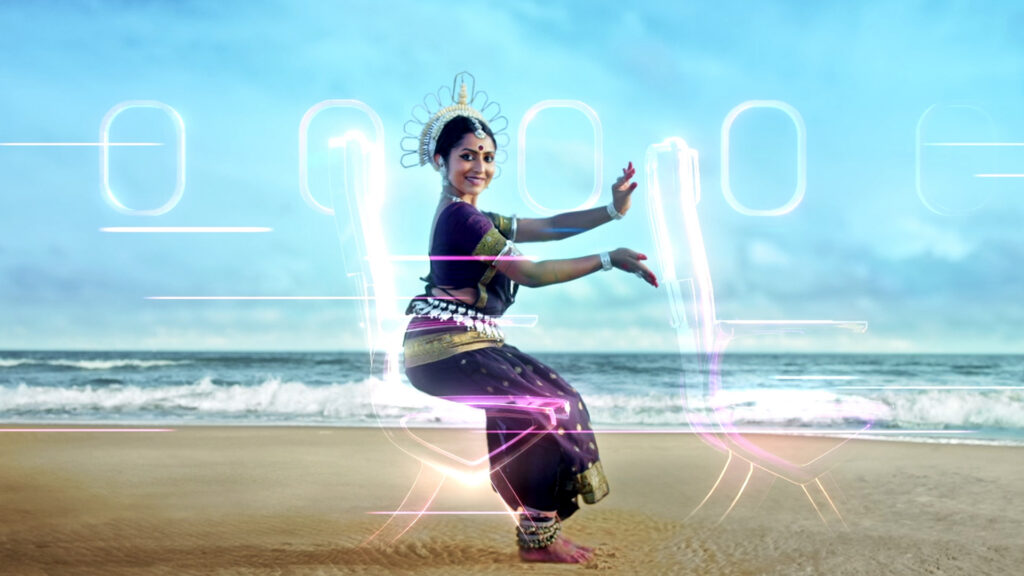
Air India’s Safety Mudras starts from something a classical dancer and a flight attendant have in common. Both use the position and movement of the body to communicate. The film pairs a range of Indian dance forms with particular procedures, using hand gestures and choreography to cue the viewer while the spoken briefing, on-screen text, and literal demonstrations carry the instructions.
The film features eight forms: Bharatanatyam, Bihu, Kathak, Kathakali, Mohiniyattam, Odissi, Ghoomar, and Giddha. Air India’s own press imagery illustrates how the two layers work together. A still about keeping the seat upright identifies the intended action in plain language. Another explains the movement needed to fasten a seat belt. Alongside the gesture, the concrete demonstration gives the viewer an action to follow. The sequence works for a passenger encountering these dance traditions for the first time.
Prasoon Joshi conceived the approach, Bharatbala directed the film, and Shankar Mahadevan composed its music. Air India describes the film as a collaboration among its safety, operations, customer experience, and brand teams. That collaboration helped align the choreography with the demands of an actual briefing. A gesture can introduce or reinforce an idea, while the framing still needs to show where the passenger’s hands go and what they do. A dance form takes on a different job in each sequence, giving the briefing room to move between traditions without losing the thread of the instruction.
EL AL Builds a Briefing Around the Destination
EL AL’s approach starts behind the camera. The airline worked with virtual production company Voia on a single campaign designed to produce versions tailored to 50 destinations. Gal Gadot, Rotem Sela, Deni Avdija, and Lior Raz feature in the series. Voia says the principal filming took two days. Its account describes an AI-assisted workflow for placing recorded performances in different virtual settings.
For the passenger, a destination reference can make the briefing feel specific to the flight ahead. For the airline, the format raises a production question with a practical consequence. How much of a safety film can an airline change from route to route while keeping the briefing recognizable and dependable? The setting and local details can vary. The timing, visibility, and wording of the procedural demonstrations need to work in each finished version.
That distinction also gives the project relevance to airlines considering how to update their own briefings. A production team can design a stable set of instructional sequences and leave space around them for route-specific scenery. It can then review the resulting versions for what a passenger sees and hears, including whether a new background competes with equipment or on-screen text. Voia’s figure describes the scope of the campaign. Its significance for an awards comparison comes from what that workflow enables the airline to put in front of passengers.
Philippine Airlines Gives a Soap Opera a Safety Plot
Philippine Airlines opens its Safetynovela with a question worthy of prime time. What do you have to do to keep your love safe? The plot draws on familiar Filipino television conventions, including a love triangle, family tensions, and a wedding storyline. Film director Marius Talampas shot in locations including Hacienda Rosalia in Negros Occidental, Daraga Church in Albay, and Malcapuya Island in Palawan.
In its APEX submission, the airline says it built the plot around the sequence of safety procedures in the Civil Aviation Authority of the Philippines’ guidelines. The drama gives people a reason to follow the next scene, and the crew demonstrations give each of those scenes a specific teaching job. That relationship matters because a viewer can easily remember a plot twist and miss an instruction delivered at the same time. Giving the safety beat its own visual space keeps it available to a passenger who follows the plot through subtitles or joins the scene midway through.
The production also found an audience beyond the cabin. Philippine Airlines released the film on its own YouTube channel and extended the campaign with a festival trailer and additional material. Inside the cabin, the film still has to convey a distinct action at each beat. When the story moves from a confrontation or a romantic reveal into a safety demonstration, can someone who has never seen a Filipino telenovela still tell what action the crew wants them to take?
SWISS by Spafax Builds Its Story Around Coming Home
In the SWISS film, a traveler packing in New York recalls the people and places waiting for her back in Switzerland. The narrative moves through hikes, trips by road, lakeside moments, and family gatherings in Zurich and Geneva. For its visual language, the film draws on SWISS Senses, the airline’s approach to its new cabin experience. A familiar sight or setting can bring a whole experience back to mind. Here, those recollections help move the viewer from one short scene to the next.
SWISS describes three levels of storytelling. The first establishes the traveler’s anticipation. The second introduces safety information through everyday situations. The third gives more complex procedures over to uniformed crew members, explicit demonstrations, pictograms, and graphics drawn from the safety card. For SWISS, Spafax Studio developed the concept, served as executive producer, and managed post-production. Mcqueen Films produced the film. SWISS identifies its public YouTube upload as the Airbus A350-900 version.
The modular design takes the idea beyond the premiere. Spafax’s APEX submission says the team incorporated revised guidance on power banks and personal electronic devices in May 2026 without needing a completely new production. That matters for a film expected to serve for years. The storyline can keep its rhythm while a specific procedure or instruction gets a new sequence. Each edition still needs to make sense to the passenger watching it on the aircraft where it plays.
What the Passenger Takes Away
For airlines choosing a creative approach, the useful question comes down to what the camera makes unmistakable. A close-up can clarify the operation of a buckle. A wider frame can establish where a procedure happens in relation to the seat or aisle. Choosing that perspective early gives the director a practical way to make story and instruction work together.
The differences become more apparent when the briefing has to work across languages. An overhead shape or an action demonstrated by a crew member can give the viewer a visual anchor before a translated line appears. A story that depends on dialogue asks more of the subtitle track. Timing matters in either case. The passenger needs enough time to read a caption and still see the movement it describes. These films offer five different ways to manage that split attention, from putting the action in the center of the frame to briefly handing the scene over to the crew.
A tug-of-war rope, a dancer’s hands, a familiar destination, a wedding scene, and the memory of a trip home can all give a passenger a reason to notice a screen. Each film makes a different decision about what happens in the next few seconds. Some use the moment to make a visual association. Others pause the narrative and let a professional demonstrate the action with the actual equipment. Once a scene has the passenger’s attention, the demonstration has to put the action in plain sight.