


AIX 2026: Neo Space Group Expands In-flight Connectivity with Saudia Launch and Global Partnerships

Share

At Aircraft Interiors Expo 2026, Neo Space Group (NSG) showcased its growing role in shaping next-generation in-flight connectivity (IFC) across global aviation markets. The company announced a landmark partnership with Saudia to launch one of the region’s most advanced connectivity services, alongside a multi-party framework with TCI Aircraft Interiors and Türksat.
Saudia Partnership Sets a New Benchmark for Connectivity in the Middle East
NSG’s first announcement at AIX 2026 was a partnership with Saudia to launch a next-generation inflight connectivity service across the airline’s network. The initiative is one of the most advanced in the region and marks a major step forward in Saudi Arabia’s Vision 2030 digital transformation.
Under the agreement, Saudia plans to introduce complimentary high-speed internet for all passengers, becoming one of the first airlines in the Middle East to offer free broadband connectivity at scale. The service runs on NSG’s Skywaves platform and uses the SES Open Orbits network to deliver fast, low-latency performance across global routes.
This approach reflects a growing shift in airline strategy. As passenger expectations evolve, connectivity is increasingly seen as a core part of the travel experience rather than a premium add-on. By offering free, high-speed internet, Saudia is positioning itself to compete more effectively in a global market where seamless digital access is becoming standard.
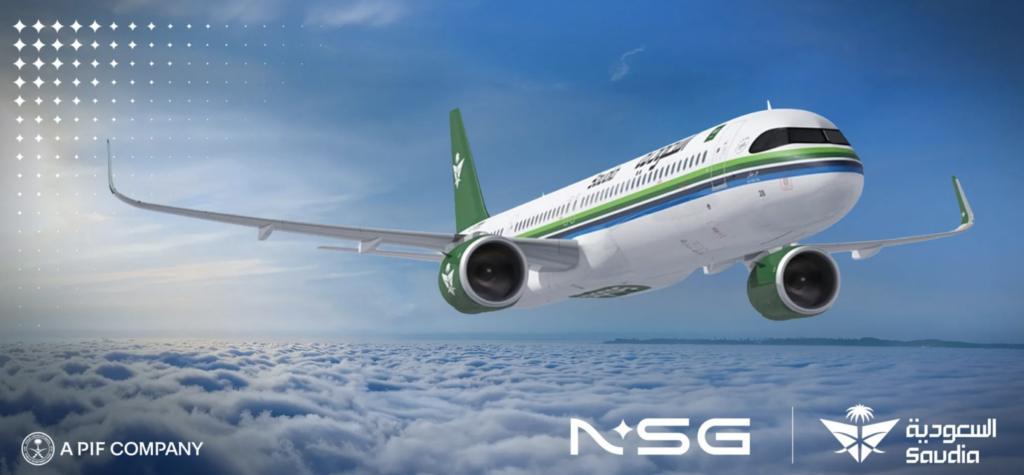
The service is built on a multi-orbit system that combines geostationary (GEO) and medium-Earth-orbit (MEO) satellites. This allows for faster speeds and lower latency than single-orbit systems, creating a more consistent and reliable experience for passengers.
The deployment also integrates the ThinKom Ka2517 antenna, supplied through Eclipse Global Connectivity, ensuring compatibility with multi-orbit operations. This combination of hardware and network infrastructure creates a scalable platform that can evolve as satellite capabilities continue to expand.
The partnership marks a key milestone in NSG’s plan to scale sovereign connectivity solutions, with aviation at the center. The company is positioning Skywaves as a unified platform capable of integrating multiple satellite networks and delivering consistent performance across fleets and routes.
Saudia Group Director General H.E. Eng. Ibrahim Al-Omar emphasized the importance of connectivity in the airline’s transformation. “Connectivity today shapes how guests experience travel and how airlines differentiate themselves in a competitive global market,” he said. “This partnership allows us to elevate the onboard experience while reinforcing our broader digital ecosystem.”
NSG CEO Haithem Alfaraj shared a similar view, framing the initiative as part of a broader national ambition. “This partnership embodies the spirit of Saudi progress,” he said. “Aviation is a strategic priority for NSG, and this milestone brings high-speed connectivity to passengers across the Kingdom and around the world.”
The rollout also highlights Saudi Arabia’s growing role in the global space and aviation sectors, combining local satellite expertise with airline operations to build a more competitive, technology-driven ecosystem.
Multi-Partner Deal Expands Multi-Orbit Connectivity
Alongside its work with Saudia, NSG announced a tri-party agreement with TCI Aircraft Interiors and Türksat to establish a new framework for multi-orbit in-flight connectivity. The collaboration brings together satellite capacity, onboard systems, and network management into a unified ecosystem designed to support next-generation connectivity.
The agreement is initially focused on the Turkish aviation market, one of the fastest-growing regions in global air travel. However, the framework is designed to scale across additional markets, enabling airlines to deploy flexible, high-performance connectivity solutions across different regions and operating environments.
The system is built on a multi-orbit setup that combines geostationary (GEO), medium-Earth-orbit (MEO), and future low-Earth-orbit (LEO) satellites. This approach helps airlines deliver more consistent connectivity by balancing coverage, speed, and capacity across routes.
Each partner plays a distinct role in the ecosystem. Türksat provides satellite capacity, ground infrastructure, and network operations, acting as the main contractor. NSG brings its Skywaves platform to manage traffic and connect different satellite networks. TCI Aircraft Interiors handles integration, connecting the space systems with the aircraft cabin.
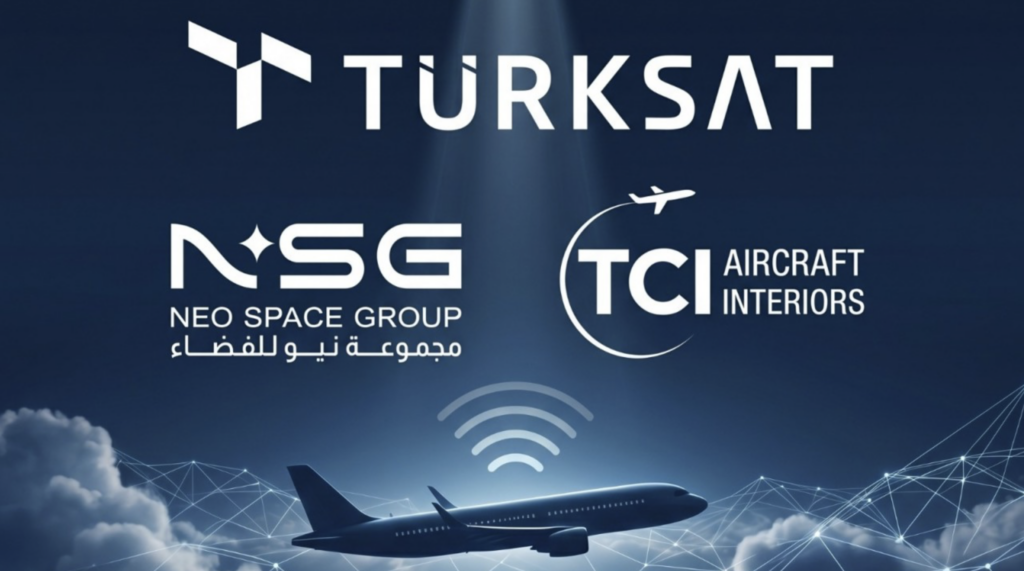
This model reflects a shift in how connectivity is delivered. Rather than relying on a single provider, airlines can adopt a more flexible approach that combines multiple capabilities into one solution.
Neo Space Group Executive Vice President of Aviation Tarek El Mitwalli, highlighted the strategic importance of the partnership. “This collaboration allows us to both contribute to their programs and further enrich our Skywaves offering, strengthening our ability to serve existing and future airline customers with flexible, multi-orbit connectivity solutions.”
This framework gives airlines more flexibility in how connectivity is rolled out and managed. It works for both new aircraft and retrofits, making it easier to deploy across different fleets. It also allows network resources to be adjusted in real time, helping maintain consistent performance across routes and changing traffic conditions.
The collaboration is expected to bring its first aircraft into service in early 2027, marking an important step toward wider rollout. By combining satellite infrastructure, onboard systems, and network integration, the partners are building a more scalable and flexible connectivity platform.
“By combining our strong satellite infrastructure and operational capabilities with the innovative multi-orbit technologies of Neo Space Group and the integrated solutions expertise of TCI, we are creating a powerful ecosystem for next-generation in-flight connectivity. We are proud to support the growing demands of Türkiye’s aviation industry while contributing to a scalable framework that can serve airlines across global markets,” said Türksat Deputy General Manager Satellite Services Dr. Selman Demirel.
TCI CEO Müjdat Uludağ reinforced the role of integration in this model. “We are not just installing hardware. We are orchestrating a multi-orbit digital ecosystem that enables airlines to deliver a more flexible and high-performance passenger experience,” he said.