


How Thales Keeps its IFEC Innovations “Forever Young”

Share

APEX Insight: Recognizing that technology comes and goes, Thales engineers challenge the tests of time by imagining ways to extend the lifespan of its in-flight entertainment and connectivity innovations.
The wish for eternal youth is one we can all relate to, none more than an aerospace company. But, ironically, youth is usually a cruel afterthought. As the Greeks and Romans tell us, immortality comes first. So when Tithonus and later Sibyl begged the gods for immortality, only once they grew ancient and shriveled did they realize that longevity, perhaps tragically, loses value without vivacity. An aerospace company, like Thales, knows what Tithonus and Sibyl didn’t.
“We’re a very impatient community today, to wait for that hourglass.” – Fred Schreiner, Thales
THIS DAY AND AGE
It takes approximately 1,992 hours to build a Boeing 777, but in those 83 days of labor, it’s built to last. This life cycle makes designing and supplying the aircraft’s electrical systems a race against time. “Even if you select a technology today, it’s going to get on an airplane one or two years from now, and it will stay on that plane for maybe 10, 15, 20 years,” says Duc Huy Tran, vice-president of Strategy and Marketing, Thales InFlyt Experience.
I’m sitting in a Thales Avionics boardroom on Discovery road in Irvine, California, discussing time and technology with Tran and Fred Schreiner, chief technology officer for Thales InFlyt Experience – both aficionados in this realm. As if programmed, we all simultaneously glance at our personal electronic devices (PEDs). Mine, an iPhone 5s, was shiny and new way back in 2013. Three years in, it’s shamefully out of date and aged by four successors and counting.
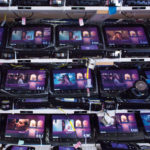
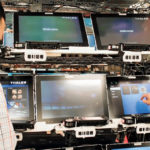
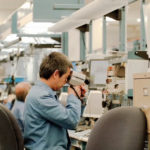
“We’re a very impatient community today, to wait for that hourglass,” says Schreiner. “It’s one of those things we have to think about – the proliferation of the PED and the technologies that come out every 12 months – when we’re building something that needs to be relevant for 10 years or more.” In other words, the technology that we send up into the sky needs to stand the test of time on a clock that’s ticking fast.
CABINET OF CURIOSITIES
Enter Brett Bleacher. “Our CEO and many corporate visitors say to me, ‘Brett, you have the best job at Thales,'” he says. His official job title, director of Innovations and R&D for Thales Avionics, does it no justice. Unofficially, his work involves more of a cross between Dr. Emmett Brown’s Back to the Future inventiveness and Willy Wonka’s factory of pure imagination. His job, the stuff of movies, is to beat time.
In Building 58 on Discovery road, Bleacher leads Tran, Schreiner and me to an unassuming room marked by a lackluster plaque labeled “Innovation Lab.” As he unlocks the door and enters secret passwords that most Thales employees don’t even have access to, he turns and roguishly tells me, “They call this my man cave.” Entering the man cave, it’s easy to see why it’s earned such a reputation.
“The way I view it is, what you want to get on an airplane is a platform that can grow.” – Duc Huy Tran, Thales
As if summoned, gadgets and gizmos light up the dark room and fill it with an electric buzz. In the far corner, a holographic flight attendant named Nana springs into service. On the other side, Li-Fi begins streaming video through light beside another hologram of a frog. “Do you know what the smell is?” Bleacher asks, activating smell-o-vision in another corner. “Chocolate?” I wager. “You’re close. This one happens to be coffee,” he says. Other aromas include orange blossom, Pacific Ocean breeze, redwood forest and hot apple pie. “My favorite is chocolate chip cookie – just need some fat-free milk to go with it,” he jokes.

As the wonder begins to abate, I remember that a minute ago we were talking about airplanes. What does a holographic frog and hot apple pie have to do with an airplane? “We stay ahead by thinking outside the box,” explains Bleacher. By leveraging new consumer technologies, maintaining close relationships with third-party techies and regularly hitting up the aerospace, automotive, gaming and electronic tradeshow circuits, Bleacher and his team draw upon what’s out there and invent ways for it to work in an aircraft cabin environment.
“It’s all part of the innovation process,” adds Schreiner. “We start with the market, we develop a product roadmap, and then something called a technology insertion strategic plan.” Some technologies that Bleacher explores remain in his cabinet of curiosities, but the ones that show promise are installed and demonstrated in a state-of-the-art immersive business-class seat and brought to shows like APEX and AIX.
“Visitors of all kinds – airline customers, employees, university students, corporate visitors and news media – are amazed at what they see in the Innovation Lab,” Bleacher says. Not surprisingly, feedback can be as quirky as the technology itself. Once, he placed a pneumatic gaming vest on a visitor and activated an aliens attack game. “When he felt the pressure in his back from the simulated attack, he thought someone from the group was jabbing him … We all started to laugh, since it was actually the pneumatic vest jabbing him from behind as the aliens attacked him,” says Bleacher. All in a day’s work.
THE SOFT TOUCH
Outside of the Innovation Lab, Thales has found other ways to cheat time, and when it comes to in-flight entertainment (IFE), it has to. The company’s primary competitor, Panasonic Avionics, commands somewhere near 70 percent of the global embedded IFE market share.
“The way I view it is, what you want to get on an airplane is a platform that can grow,” explains Tran. Technology on the ground is updating constantly, but many of the updates come in the form of software-based applications. “What allows us to close the gap is building an applications platform so that you can add new applications as they come,” he says.
“It’s really about shifting the emphasis to things that can be put into digital packages.” – Fred Schreiner, Thales
“It’s really about shifting the emphasis to things that can be put into digital packages,” Schreiner adds. Around five years ago, Thales transitioned from Linux to an Android operating system, because Android offered a secure method of opening the platform up to app developers. The move not only allows Thales to recruit fresh talent from the dev world, but also allows airlines using Thales’ systems to more easily customize and differentiate their offering.
For customer Qatar Airways, Thales recruited Doha-based Fuego Digital Media – a company with one of the most sophisticated content management systems for authoring and publishing in both Arabic and English – to develop a duty-free shopping application and others. As Schreiner explains, “Qatar likes the fact that we can use local talent to develop these applications. The freedom to be able to do that … it’s really positive.”
For Thales, the focus on software is also a great way to stay in touch with the developer community. Representatives regularly attend Android developer and gaming tradeshows like AnDevCon and GDC. At one conference, they gave out squishy airplane-shaped stress-reliever toys with Thales branding. The supply ran out so fast, “We mused about whether this was a reflection of the stress level of today’s app developers or a reflection of how much they love Thales,” Schreiner jokes.
THE HARD STUFF
Despite the benefits of a software-driven shift in Thales’ IFEC value proposition, “You never get away from hardware,” Schreiner notes. And it’s the hardware that can date a system before you start using it. “You see it on some of the older airplanes we fly, small six-inch screens with a very large frame. Even before it starts playing, you’ve got your iPad or whatever, and you’re going to be drawn to that instead.”

Industrial design is harder to cheat. Not only is the cabin environment heavily regulated, but the equipment is also built to withstand much higher utilization rates than our PEDs. Thales products are qualified for one million screen touch and button pushes, 100,000 audio jack removals and insertions, impact from suitcases and clumsy passengers, drink and food spills, extreme heat, extreme cold and even resistance to intentional physical abuse.
In terms of design, Thales employs a measured balance between ergonomics and integration with the look and feel of the aircraft cabin and seats. “Our fixed installations, such as Avant seatback displays, which have a curved lower surface contour, were designed to be complementary to seat design and cabin bag rack and sidewall architectural lines,” Schreiner says.

TIME WORKS WONDERS
“We’re an innovative bunch,” Schreiner says with equal parts pride and modesty. “We’re not Google in terms of moving around on skateboards, but we are certainly very agile innovators.”
Much of staying ahead of time lies in guessing at the future. But perhaps no one can appreciate the enormity of the task more than the pre-Socratic Greek philosopher Thales himself, famous for the words: “The past is certain, the future obscure.” It may be so, but as I left 58 Discovery road, I felt as if I had been privy to a partial glimpse.
“Forever Young” was originally published in issue 5.6 of APEX Experience magazine.