


Skyline IFE Deploys AI-Driven App for IFE Screening, Content Moderation

Share
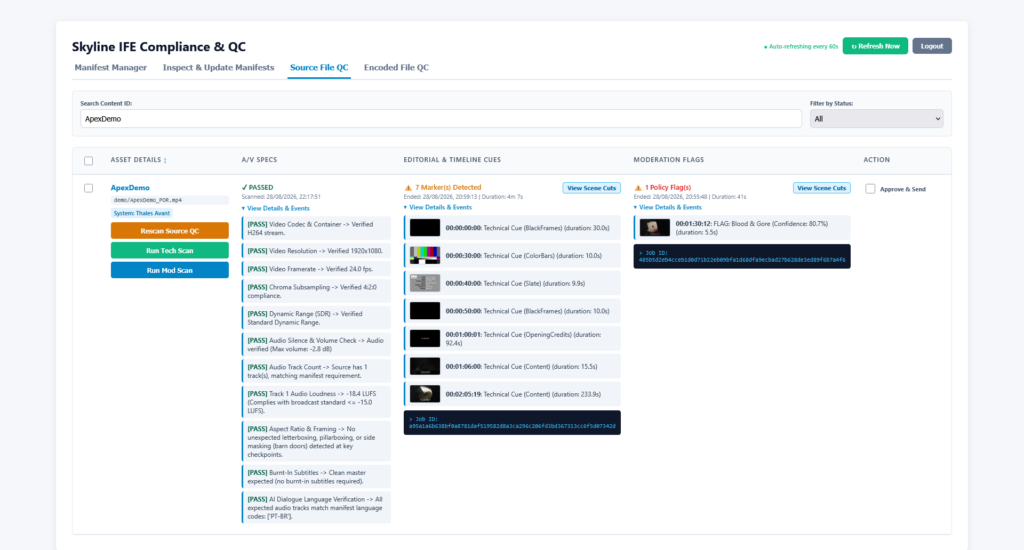
The strategic use of AI as a time-saving, accuracy-improving, cost-cutting solution within the in-flight entertainment (IFE) content supply chain is a shift the APEX community has been discussing for a few years now. Previous attention has been placed on AI’s ability to assist in metadata generation, but the most recent slew of developments focuses on AI’s ability to flag inappropriate content much faster than human viewers.
Skyline IFE is one such company exploring this capability. It recently built a suite of AI media content moderation tools that can quickly and accurately scan movies for inappropriate content, as well as to check if the digital file meets the necessary technical requirements for airline IFE systems. The company’s Managing Director Richard Barsby details how the solution works.
AI’s Numerous Relevant Capabilities
“We built the new tools into the quality control (QC) engines we use in our transcoding pipeline to check media content files sent by content suppliers,” stated Barsby. “Incoming files are automatically scanned to check they meet the specifications required technically and for language identification, video artifacts, black frames and more.
“AI is used to check that the principle dialogue language in each of the audio tracks is the language specified, including the detection of regional variation” Barsby continued. “So, for example, the AI can distinguish between Latin American Spanish and Castilian Spanish tracks in the same multiplexed file.
“We are seeing the AI flagging the same images for moderation as our human reviewers.”
“The source files can also be scanned to detect technical cues such as bars/tone, black segments and pre-programme ‘slates.’ This is useful as an automated check to detect if there are any residual technical elements of the original master in the airline version, such as a black segment used to identify an ad break.
“Lastly, we can apply a content moderation AI to check the file for a large number of moderation ‘flags,’ including explicit nudity, suggestive content, violence, visually disturbing images, rude gestures, drugs and tobacco, alcohol, gambling and hate symbols.”
A Constantly Changing Landscape
When deciding which technology to use to build these new tools, Barsby noted that Skyline IFE researched extensively to find a solution that had the ability to work quickly at scale while remaining reliable and cost-effective: “We needed something that can support a seatback customer with potentially thousands of files entering service every month. Our engines can scan hundreds of files simultaneously, with scan times varying between three minutes for a 30-minute TV show to 15 minutes for a three-hour film.”
While Barsby believes that “reliable AI reduces the need for human intervention,” he confirmed that Skyline IFE is currently using AI together with human review to determine just how much it can reliably hand over to the engine.
“It is possible to create reliable audio announcements using AI that sound human.”
“It takes around ten minutes for the app to ‘watch’ a 90-minute film and produce the report. The output is then reviewed by a human moderator who decides if the file can continue through to encoding or to “stop press” and send the file back for editing. We are seeing the AI flagging the same images for moderation as our human reviewers,” he claimed.
“AI technology is advancing so fast that what was considered beyond the scope of machine learning six months ago is already becoming workable,” Barsby explained. “We have a version of our QC engines now in service, but we are constantly redeveloping our applications to take advantage of the new advances in AI content moderation. As we build these tools in-house we can respond to new developments promptly and customize our software and moderation policies to an airline client’s individual needs.”
AI to Move from Back Office to Center Stage?
Looking to the future, Barsby predicts AI will take on an increasing amount of “voice work,” first in the airline cabin and then on the IFE screen. “The advances in language translation, text-to-speech and regional language dubbing have now matured to the extent that it is possible to create reliable audio announcements using AI that sound human,” he remarked. “While this is difficult news for professional voiceover artists, the commercial and operational advantages of using AI to produce professional pre-recorded announcements in multiple languages are significant.”
“AI technology is advancing so fast that what was considered beyond the scope of machine learning six months ago is already becoming workable.”
In the longer term, Barsby also anticipates that AI-generated audio could master “additional emotional context either from scripted direction or imitation of the original language dialogue track.
“While pre-recorded announcements are factual texts and the tools to reproduce multiple language versions are within the grasp of production companies and consumers alike, managing the complex emotional interactions of a high stakes movie drama or radio play is still a developing science,” he said. “There are tools in the market place that do a pretty good job already, but even in Hollywood the current opinion is that there is still some way to go before an AI dub can realistically mirror deep, nuanced or very specific emotional subtext.”